
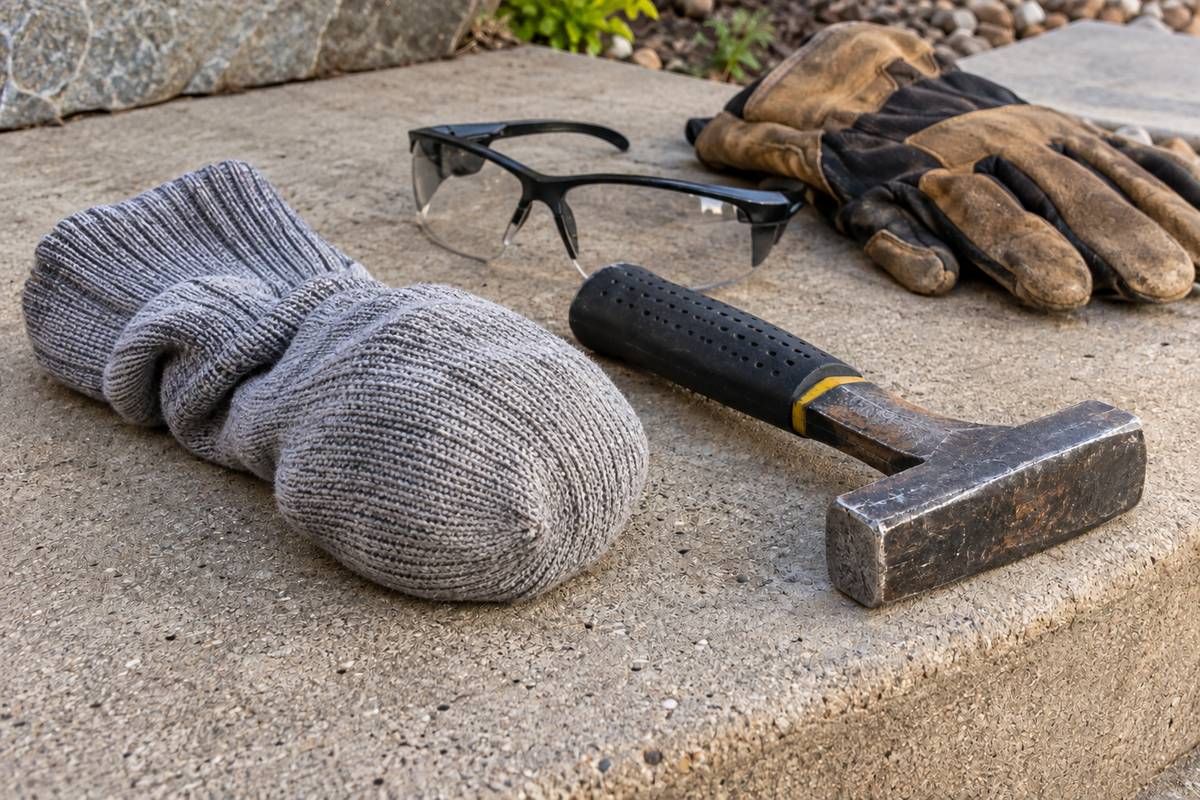
The easiest way to open a geode at home is to put it in an old sock and set it on a hard surface outside. Then tap it around the middle with a hammer until it cracks. For two clean, even halves, use a hammer and chisel to score a line around the middle, or squeeze it open with a chain-style pipe cutter. For a flat, polished face, have it cut on a rock saw. Whatever you choose, wear safety glasses. Rock chips fly fast and can go in any direction, and the sharp edges inside a geode can cut. And be ready for a surprise: not every geode is hollow.
Field to Polish is a participant in the Amazon Services LLC Associates Program, an affiliate advertising program designed to provide a means for sites to earn advertising fees by advertising and linking to Amazon.com.
In This Guide
Before You Start: Is It Hollow?
A geode is a round rock with a hollow space inside, usually lined with quartz crystals. From the outside, though, a hollow geode and a solid one can look almost the same. Both tend to be round and lumpy, with a rough, bumpy rind that some people compare to cauliflower.
Weight is one of the most useful clues. Pick up the rock and compare it with others of the same size. If it feels lighter than it should, it may be hollow. Geologists call weight “a good hint,” but it doesn’t guarantee anything. Some people also hold each geode up to one ear and shake it. A rattle can mean loose crystals or bits of rock inside a hollow center, but many hollow geodes make no sound at all.
Plenty of round rocks turn out to be solid all the way through. Some are filled with quartz, agate, or calcite. Others are just rock. A solid one is not a failure, and we cover what to do with it near the end. If you are still hunting for geodes to open, our guide to where to find geodes covers the best US spots and the collecting rules at each one.
What You Need
For the simple methods, you only need a few things:
- Safety glasses that wrap around the sides. Regular eyeglasses are not enough.
- Work gloves.
- An old sock, cloth bag, or towel.
- A hammer. A short, heavy crack hammer works best. A one-piece rock hammer is fine for tapping, but use a crack hammer to strike a chisel. Avoid a carpenter’s claw hammer.
- Use a cold chisel or brick chisel if you want more control over the break.
- Use a hard, solid outdoor surface, such as a concrete step or a large flat rock.
The hammer matters more than most people think. A carpenter’s hammer isn’t made for hitting rock, and its face can chip, sending a sliver of steel flying. If you plan to use a chisel, our rock hammer guide explains why a crack hammer is the right tool for driving one.
Method 1: The Sock and Hammer Method
Most people try this method first, and it works well for small geodes and kids’ kits. The sock keeps most of the chips from flying and holds the pieces together when the geode breaks.
- Put on your safety glasses and gloves.
- Slide the geode into the toe of an old sock and fold the top over.
- Set it on a hard surface outside. A kitchen counter or a wood floor can crack, dent, or let the geode bounce.
- Tap the geode’s middle with your hammer. Start with light taps and slowly hit harder.
- Turn the geode a little after each tap, so you work a line around its middle.
- Stop when you feel or hear it give, then carefully open the sock.
The downside is control. A hammer blow can split a geode into two neat halves, or it can break it into several uneven chunks. If the geode is special to you, the next method gives you better odds.
Method 2: Hammer and Chisel
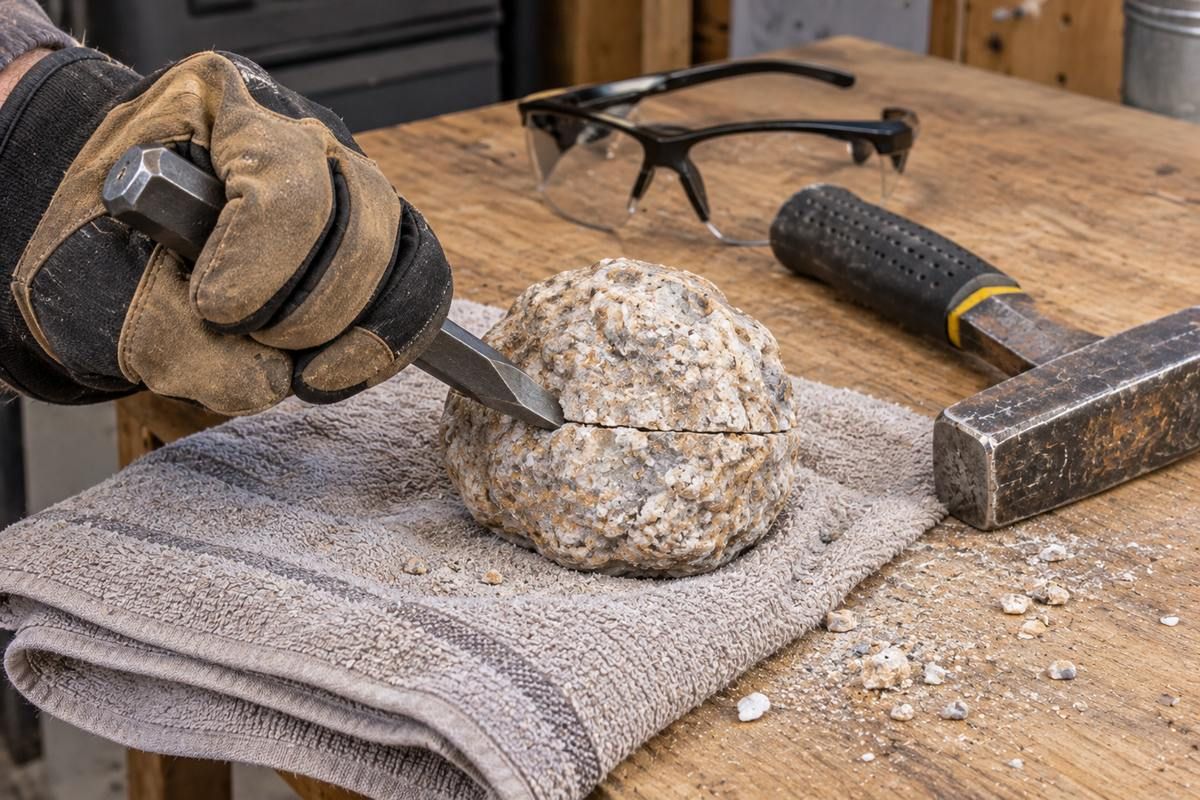
A chisel lets you decide where the geode will break. Instead of one hard hit, make a shallow line around the middle, and the geode tends to split along it.
- Put on your safety glasses and gloves.
- Set the geode on a hard surface. A bag of sand or a folded towel underneath helps keep it from rolling.
- Hold the chisel against the middle of the geode, pointing in toward the center.
- Tap the chisel lightly with the hammer, then turn the geode a little and tap again.
- Keep going around the geode until you have made a full circle.
- Go around again with slightly harder taps until it splits.
Patience is the whole trick. Most of the work happens on the second or third trip around, and hitting hard too early is the most common way to shatter a geode. Do not wrap the geode in a sock for this method, because you need to see where the chisel sits.
Method 3: A Chain Pipe Cutter
Rock shops and geode stands often crack geodes with a soil pipe cutter, sometimes called a snap cutter. It is a plumbing tool made to cut cast iron pipe. A chain with small cutting wheels wraps around the geode, and squeezing the long handles tightens the chain evenly from all sides until the geode snaps.
Because the pressure is even, a pipe cutter is one of the best ways to get two clean halves without a saw. The catch is the cost. A new cutter is expensive for a few geodes, and the chain has to fit around the geode. If you only have a handful to open, look for a rock shop, rock club, or gem show that will crack them for you. Some will do it for free or for a small fee, and some let you pull the handles yourself.
Method 4: Cutting a Geode With a Saw
A saw gives you the cleanest result: two flat faces that show the crystals like a picture and can be polished later. Rock saws use a thin steel blade with diamond on the edge, and they are cooled with a liquid while they cut.
For geodes up to a few inches across, a small trim saw is the usual tool. Our guide to the best lapidary saw compares trim saws for beginners. Bigger geodes need a slab saw, which holds the rock in a vise and feeds it slowly through the blade. Check the manual before you fill a saw with coolant. Many slab saws use oil as the coolant, and water can rust the parts. Some makers say running water will void the warranty.
Some people cut small geodes on a wet tile saw. It can work, but a tile saw is made for flat tile, not round rocks. A round geode can roll or grab the blade, putting your fingers close to a spinning blade. If you try it, clamp the geode in place and never hold it by hand near the blade. If you have never used a saw like this, it’s safer to pay a rock shop or rock club to cut your geode.
Cutting or grinding quartz also makes fine dust that can harm your lungs over time. Keep the blade wet while it cuts, and wear an N95 or better respirator for extra protection. Health officials list water spray methods as a good way to keep this dust out of the air.
Which Method Should You Use?
| Method | Best for | What you get | Main drawback |
|---|---|---|---|
| Sock and hammer | Small geodes, kids’ kits | Halves or several pieces | Little control over the break |
| Hammer and chisel | Most geodes at home | Often two halves | Takes patience |
| Chain pipe cutter | Getting clean halves | Two fairly even halves | Costly tool, size limit |
| Rock saw | Special or display geodes | Two flat, polishable faces | Needs a saw or a shop |
For a bag of mixed geodes, start with the hammer and chisel. Save your best-looking or lightest geodes for a pipe cutter or a saw, since those give the cleanest results.
Methods to Skip
You may see videos of people heating geodes in an oven or microwave, freezing them, or throwing them onto concrete. We do not recommend any of these. Heating can make a rock crack in unpredictable ways, and any trapped water can turn to steam. Throwing a geode is just a hard hit with no control, and the chips can fly in any direction. Banging two geodes together is gentler, but it is still hard to control and often breaks both rocks badly.
Also skip any method that has you hold the geode in one hand and hit it with the other. Set it down first. Rock chips and a slipping hammer are much easier to deal with when your hand isn’t in the way.
Staying Safe
Never skip eye protection, even for a quick tap. Rock chips can come off at any angle, including straight back toward you. Gloves help too, because a geode’s broken edges and crystal tips are sharp.
Kids love opening geodes, and it is a great way to get them into rocks. Have an adult hold the chisel or handle the hammer for younger children, and make sure everyone nearby is wearing glasses, not just the person swinging. Our guide to rockhounding for beginners has more ideas for getting started as a family.
What to Do After It Opens
Once you open your geode, rinse both halves in warm water and gently scrub with a soft toothbrush to remove dirt and rock dust. A drop of dish soap helps with mud from creek geodes. Let the halves air-dry before displaying them.
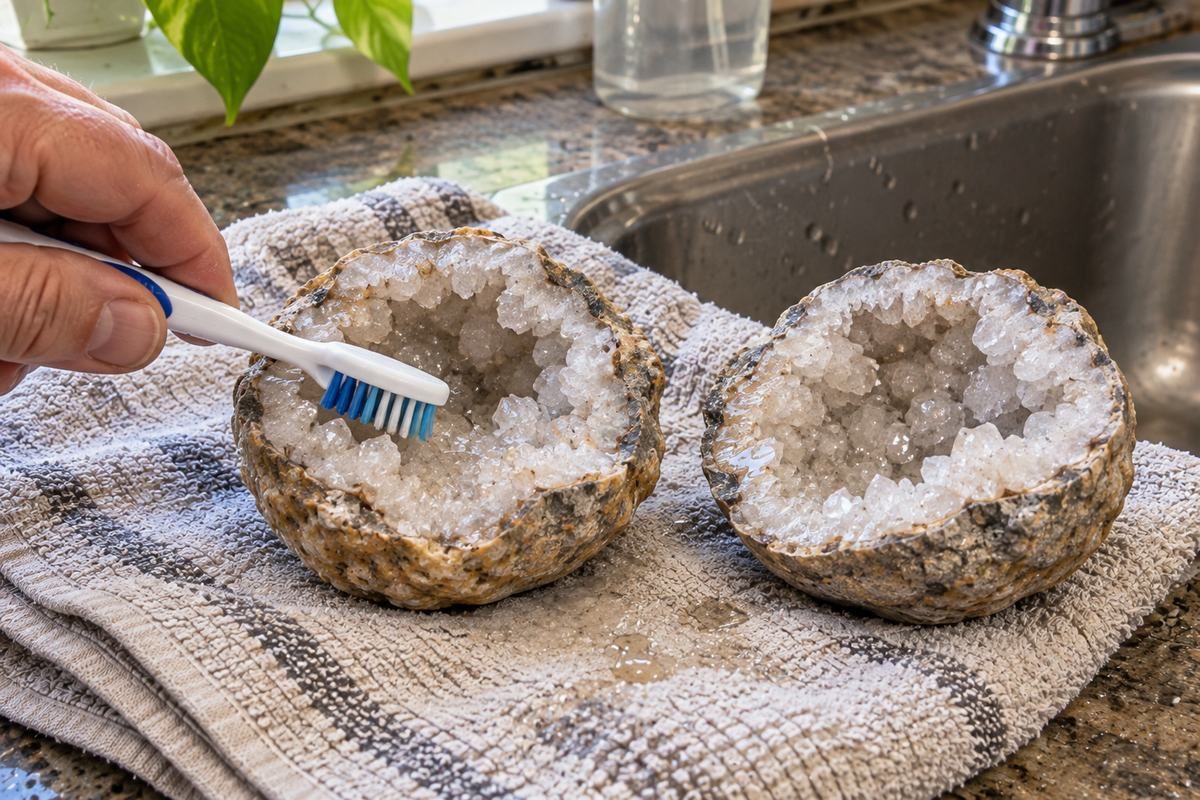
Be careful with vinegar and other acid cleaners. Vinegar dissolves calcite, so it can eat away at crystals in a geode that contains calcite. If you are not sure what the crystals are, stick with water and soap. Our guide on how to clean rocks shows which cleaners each mineral can handle.
If your geode broke into two halves, keep them together. Many collectors also write down where each geode came from, because the location can make a specimen interesting later on.
What If It Is Solid?
Sometimes you crack a rock open and find no hollow at all. It may be filled with quartz or banded agate, or it may be a plain nodule with nothing special inside. A solid nodule with agate inside can still be beautiful once you cut it flat and polish it. Our guide on how to polish rocks covers polishing by hand as well as with a tumbler.
Do not toss hollow geode pieces in a rock tumbler, though. The crystals inside are brittle and tend to break off and grind away rather than polish.
Tools Worth Having
If you plan to open more than a few geodes, two tools make the job safer and easier. The Estwing B3-3LB Drilling/Crack Hammer is a short, 3-pound hammer made for striking chisels. The 3M SecureFit 400 Safety Glasses with a foam gasket wrap around the sides and help keep dust and chips out of your eyes. A basic cold chisel or brick chisel from any hardware store completes the kit.
Gear for this guide2 items

Crack hammer
Estwing B3-3LB Drilling/Crack Hammer
A short 3-pound hammer made for striking chisels
Check Price on Amazon
Eye protection
3M SecureFit 400 safety glasses with foam gasket
Wear them whenever you strike rock
Check Price on AmazonHow to Open a Geode: Common Questions
What is the easiest way to open a geode?
Put the geode in an old sock, set it on a hard surface outside, and tap the middle with a hammer, turning it as you go. Wear safety glasses even though the sock catches most of the chips.
How do you open a geode without breaking it into pieces?
Use a hammer and chisel to work a shallow line around the middle, or use a chain pipe cutter. Both spread the force evenly. A rock saw gives the cleanest result.
How can you tell if a geode is hollow?
You cannot know for sure without opening it. A geode that feels lighter than other rocks of its size is more likely to be hollow, and a rattle can mean loose crystals inside.
Can I cut a geode with a tile saw?
You can cut small geodes on a wet tile saw, but it is risky because round rocks can roll or grab the blade. Clamp the geode in place, never hold it by hand, and keep the blade wet. A rock shop is the safer choice.
How do you clean a geode after opening it?
Rinse it in warm water, then gently scrub with a soft toothbrush and a little dish soap. Avoid vinegar if the crystals might be calcite, because vinegar dissolves calcite.
Can kids open geodes?
Yes, with an adult helping. The sock-and-hammer method is best for kids, and everyone nearby should wear safety glasses.
The Bottom Line
Most geodes can be opened with a sock and a hammer, but a chisel gives you a better chance at two clean halves. For your best geodes, a pipe cutter or a rock saw is worth the extra trouble or the small fee at a rock shop. Whatever method you use, put on safety glasses before the first tap.