
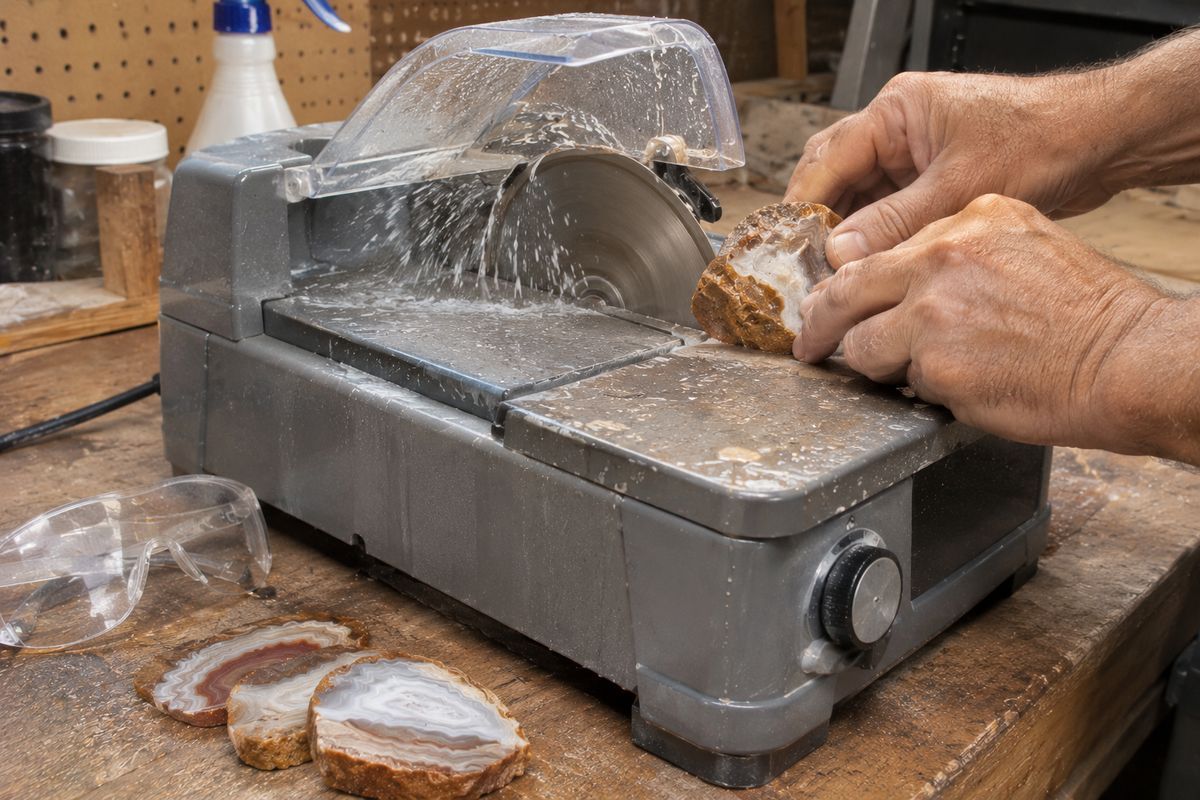
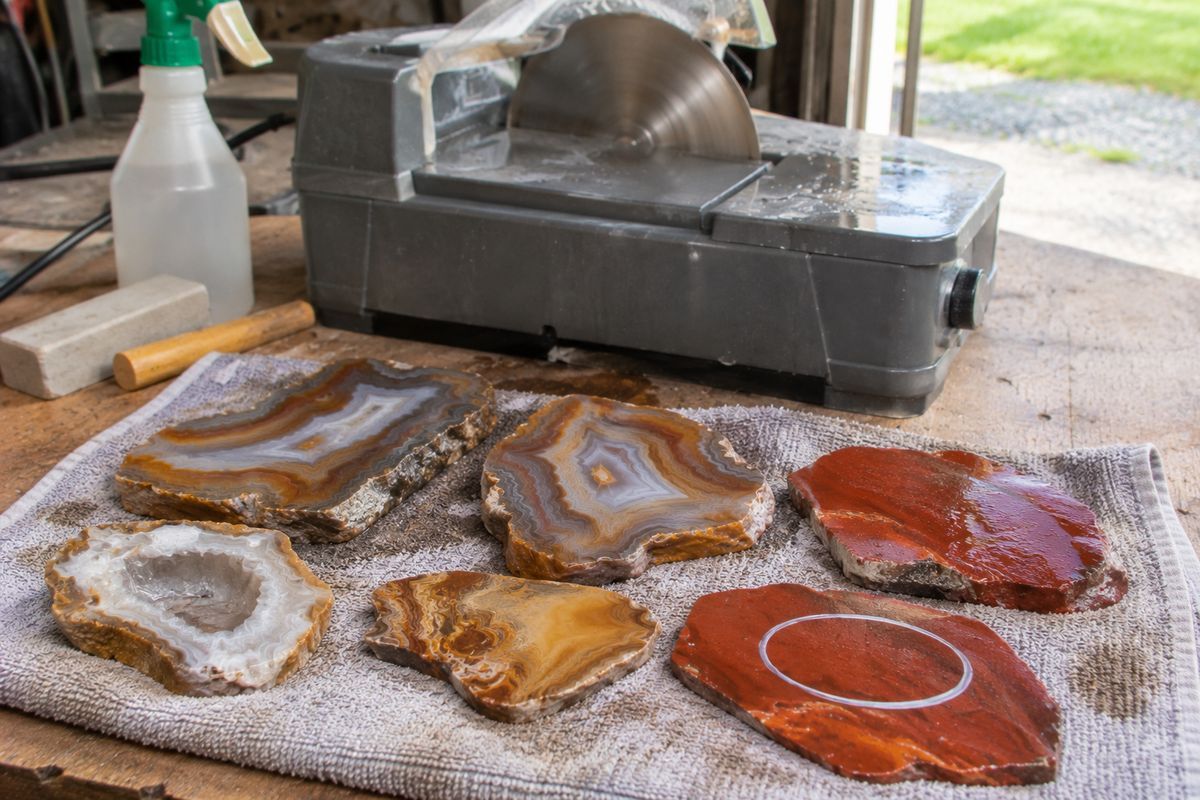
A lapidary saw is a rock saw with a diamond blade, cooled by water or oil, that cuts stones into slices and shapes. For most beginners, the best lapidary saw is a 6-inch trim saw. It sits on a bench, runs on water, and cuts rocks up to about 2 inches tall, which is enough for many agates, jaspers, and pieces of cabochon rough. A slab saw only makes sense once you need to slice bigger rocks again and again.
Field to Polish is a participant in the Amazon Services LLC Associates Program, an affiliate advertising program designed to provide a means for sites to earn advertising fees by advertising and linking to Amazon.com.
This guide is research-based. We have not used these saws ourselves. Specs come from the makers' listings and manuals, and the advice comes from lapidary guides, safety agencies, and hobbyist reports, named in each section.
In This Guide
Quick Picks
- Best first saw for most beginners: Hi-Tech Diamond 6 Inch Lapidary Trim Saw
- Best for steadier, safer cuts: Hi-Tech Diamond 6 Inch Trim Saw with Saw Vise and Fence
- Best for small stones and small spaces: Hi-Tech Diamond 5 Inch Trim Saw
- Best for cutting slabs: Hi-Tech Diamond 10 Inch Lapidary Slab Saw with Vise
- The tile saw shortcut: SKIL 3540-02 7 Inch Wet Tile Saw
Trim Saw vs Slab Saw
Lapidary saws come in two main types. The difference is how the rock gets to the blade.
- Trim saw. You hold the rock and push it into the blade by hand. Trim saws are used for small cuts, trimming slabs, and cutting the rough shape of a cabochon, which is a stone with a domed top and a flat back. Blades usually run from about 4 to 8 inches. A rock cutting guide from the Union College geology department says you need a firm, steady hand to use the small saw.
- Slab saw. A vise clamps the rock and moves it into the blade on a carriage. Many slab saws feed the rock with a motor, so the cut is slow and even. Smaller ones may have you push the carriage by hand. Blades start at about 10 inches and go much larger on big shop saws. Slab saws turn whole rocks into flat slices, called slabs.
Lapidary supplier HP Lapidary describes the same split in its guide to saw types. For a beginner, the trim saw is the usual first tool.
Blade Size and How Tall a Rock You Can Cut
Blade size determines the largest rock a saw can cut. Only part of the blade sticks up above the table, so the cut height is much smaller than the blade. On rock forums, hobbyists use about one-third of the blade size as a rough guide. Here is what the makers list for the saws in this guide.
| Saw | Blade | Listed cut height |
|---|---|---|
| Hi-Tech Diamond 5 Inch Trim Saw | 5 in | About 1.5 in |
| Hi-Tech Diamond 6 Inch Trim Saw | 6 in | About 2 in, up to about 2.25 in at the blade center |
| SKIL 3540-02 Wet Tile Saw | 7 in | Not listed for rock. One owner of a 7 in tile saw reports about 2 in. |
| Hi-Tech Diamond 10 Inch Slab Saw | 10 in | 3.75 in from table to blade top. Keep the rock under two-thirds of the blade you can see. |
Measure the rocks you have now, not the ones you hope to find. If most of them are under 2 inches tall, a 6-inch trim saw is enough.
Notched vs Sintered Blades
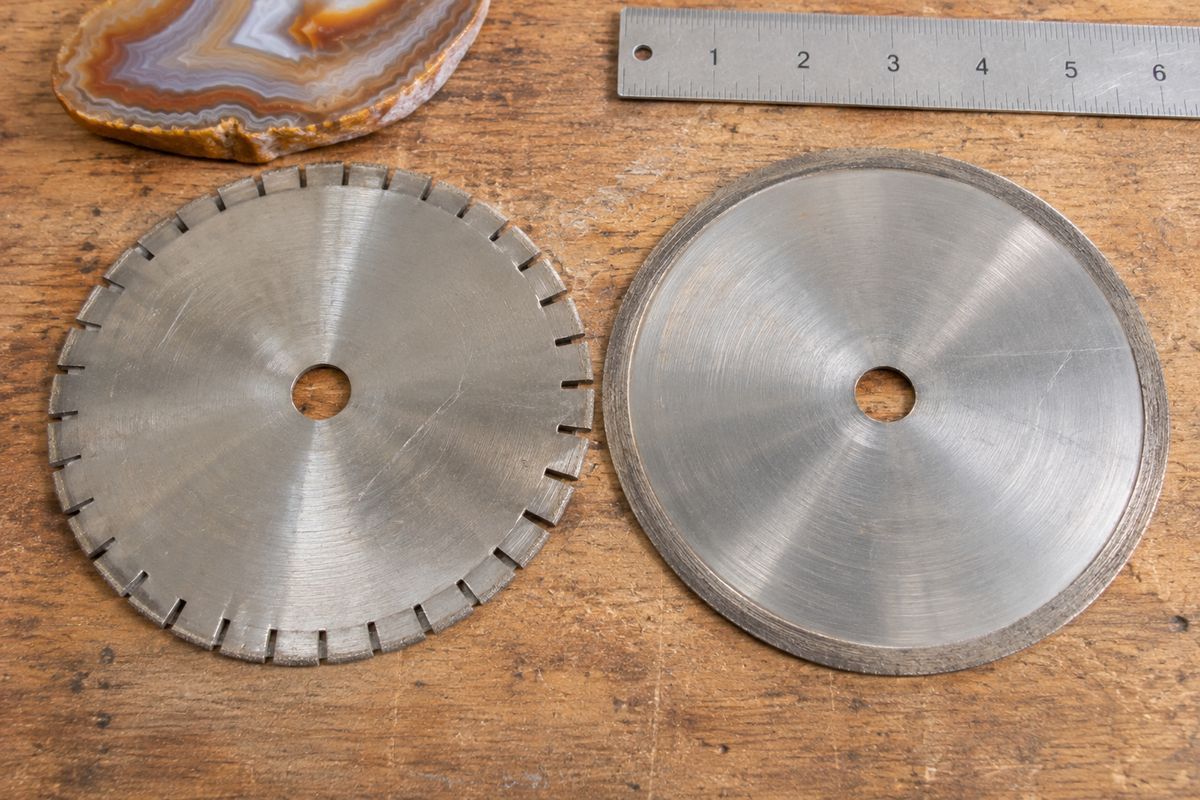
Lapidary blades do not have teeth. They grind through rock with diamond grit set into the edge. There are two common styles.
- Notched rim. Diamond is pressed into small notches around the edge. These blades leave a rougher cut face, according to gem guide SkyJems.
- Sintered or continuous rim. Diamond is mixed through a solid band around the edge. These leave a smoother face and are preferred for hard gem material, per the same guide. A Rock and Gem magazine article on diamond rock saw blades says sintered blades have largely replaced notched ones.
Blade thickness matters too. A thin blade, called a thin kerf blade, turns less of your rock into dust. That matters when the rough is costly. Very thin blades are also more delicate and flexible, so use them with care, a point gem dealer Aussie Sapphire makes in its trim saw blade guide.
The Hi-Tech 6-inch trim saw and 10-inch slab saw each come with one blade of each style. Try both, and buy more of whichever cut you like.
Water vs Oil Coolant
A lapidary saw must never run dry. The coolant keeps the blade from overheating and carries rock dust away. Hi-Tech's manual says never to run the blade dry.
- Water. HP Lapidary says trim saws usually run on water, sometimes with an additive mixed in. Water is cheap and easy to clean up. Hi-Tech recommends water for its saws, with an optional coolant added. The catch is that water only cools. It does not lubricate, and blade maker MK Diamond says it can shorten blade life and rust the arbor, which is the shaft the blade sits on.
- Oil. Slab saws have long used oil for big cuts, per the same guide. Oil lubricates the blade and stops rust. It also makes a fine mist, which is why oil slab saws usually have a hood. A Rock and Gem article on dangerous rock dust warns that the mist can carry harmful dust.
If you use oil, use a saw oil made for the job. MK Diamond warns never to use diesel, kerosene, or heating oil, because they can catch fire. Its coolant guide notes that shop fires have started this way.
Can You Use a Tile Saw to Cut Rocks?
Yes, with limits. Hobbyists commonly cut rocks on wet tile saws, and the SKIL saw in our picks is a common choice. Here is what to expect, based on reports on the Rock Tumbling Hobby forum.
- Blades wear fast. Tile blades run at high speed and dull quickly on thick rock. Lapidary supplier Kingsley North also says many tile blades are not suited to lapidary work because of their high RPM.
- Short cut height. One forum member said a 7-inch tile saw cut rocks only about 2 inches tall.
- Round rocks roll. A tile saw table is made for flat tile. Round rocks can shift and push the blade off line. Forum members glue rocks to a board or set them in plaster first.
- Clamp the stone. A loose rock can bind the blade and kick back. Clamp it so it cannot move.
A tile saw is fine for a few flat rocks or for opening a geode now and then. Our guide on how to open a geode covers other ways too. If you plan to cut rocks every week, a lapidary trim saw is the better buy.
Rock Saw Size Checker
Choose your rock size and what you want to make. The checker suggests a saw type and blade size.
Rock Saw Size Checker
Pick your answers to see which saw size fits your rocks.
Saw size checker by Field to Polish. Cut heights from Hi-Tech Diamond listings and manual. A rough guide only.
Best Lapidary Saws to Buy
Every lapidary saw pick here is sold on Amazon by Reentel International, the company behind the Hi-Tech Diamond brand. Amazon sells the SKIL tile saw. We checked each listing on 5 Nov 2026.
Pick 01Best first saw for most beginners
Hi-Tech Diamond 6 Inch Lapidary Trim Saw

Six inches is a common size for hobby trim saws, and this one fits on a bench. Hi-Tech Diamond lists a 1/4 HP motor with a speed dial that runs from 800 to 3,400 RPM.
It comes with two 6-inch blades: a thin notched blade and a thin sintered blade. That lets you try both styles and learn which one you like before you buy more. It uses water from a small built-in tank, so you don't need to buy or clean up oil. A vise and fence are not part of this listing. If you want them, see Pick 02.
- Blade: 6 in, one notched and one sintered included
- Motor: 1/4 HP, 800 to 3,400 RPM variable speed, 115V
- Cut height: about 2 in, and up to about 2.25 in at the center of the blade
- Coolant: water, built-in tank holds up to 16 oz
- Table: 15.5 in by 9 in
- Weight: about 15 lb
Pick 02Best for steadier, safer cuts
Hi-Tech Diamond 6 Inch Trim Saw with Saw Vise and Fence

This is the same 6-inch saw bundled with a vise and a fence. The vise holds the rock, so your fingers stay farther from the blade. Hi-Tech's own manual tells users to hold rocks in a vise to keep hands away from the blade. The fence is a straight guide that helps you cut uniform slices.
Pick this one if you plan to cut slices for cabochons or if you are nervous about feeding rocks by hand. Buying the bundle also saves hunting later for a vise that fits.
- Blade: 6 in, two blades included
- Extras: saw vise and fence
- Cut height: up to about 2 in, per the listing
- Motor: 1/4 HP, variable speed
- Coolant: water
Pick 03Best for small stones and small spaces
Hi-Tech Diamond 5 Inch Trim Saw

The 5-inch model uses the same 1/4 HP variable-speed motor in a smaller body. It weighs about 10 pounds, so it is easy to set up on a kitchen table and put away afterward. The tradeoff is size. It cuts rocks up to about 1.5 inches tall, and the vise for the 6-inch saw does not fit it.
It makes sense if you mostly trim small tumbled stones, thin slabs, or rough for small cabochons. If you hunt for fist-size agates, get a 6-inch saw instead.
- Blade: 5 in, one included
- Motor: 1/4 HP, 800 to 3,400 RPM variable speed
- Cut height: up to about 1.5 in
- Coolant: water, built-in tank holds about 8 oz
- Table: 7.5 in by 4.75 in
- Weight: about 10 lb
Pick 04Best for cutting slabs
Hi-Tech Diamond 10 Inch Lapidary Slab Saw with Vise

A 10-inch blade is where most slab saws start. This one has a stronger 1/3 HP motor and comes with a vise to hold the rock, plus a notched blade and a sintered blade. Hi-Tech's manual recommends water as the coolant and says you can also use oil. You fill the tank until the bottom of the blade sits about 1/8 inch deep.
Check your rock sizes before you buy. The manual lists 3.75 inches from the table to the top of the blade. It also says the rock should be no taller than two-thirds of the blade you can see. So this saw is better for steady, repeated cuts in a vise than for cutting much taller rocks. You push the vise carriage into the blade by hand, since this saw has no power feed. For big rocks, you need a larger slab saw, which most beginners do not need.
- Blade: 10 in, one notched and one sintered included
- Motor: 1/3 HP, single speed, about 1,740 RPM
- Extras: saw vise
- Coolant: water recommended, oil can be used
- Table: 14 in by 10 in
Pick 05The tile saw shortcut
SKIL 3540-02 7 Inch Wet Tile Saw
Hobbyists commonly cut rocks on wet tile saws. The SKIL 3540-02 is a compact 7-inch model sold by Amazon. It runs at 3,600 RPM and has a table that tilts from 0 to 45 degrees.
It is a shortcut, not a lapidary saw. Hobbyists on rock forums report that tile blades wear out fast on thick rock, and one owner said a 7-inch tile saw only cut rocks about 2 inches tall. The flat table also makes round rocks hard to hold. Use it for flat or blocky rocks, clamp or glue the stone to a board, and expect to buy blades more often.
- Blade: 7 in tile blade
- Motor: 4.2 amp, 3,600 RPM
- Table: tilts 0 to 45 degrees, takes 12 in by 12 in tile
- Coolant: water
- Weight: 18 lb
How to Cut a Rock With a Trim Saw
- Check the rock. Clean it so you can see cracks. Our guide on how to clean rocks can help. Look up the rock first. Some, such as malachite, are toxic to cut, and some may contain asbestos (see the safety section below).
- Fill the coolant. Fill the tank to the level in your manual. The blade must dip into the water or oil before you turn it on.
- Put on safety gear. Wear safety glasses or goggles with side shields.
- Plan the cut. Mark where you want to cut. Lay the rock flat on its most stable side, or clamp it in the vise.
- Start the cut slowly. Let the blade reach full speed. Then feed the rock in with light, steady pressure. Pushing hard makes the blade dig in and heat up.
- Keep your fingers clear. Use the vise when you can, so your hands stay away from the blade. A diamond blade has no teeth, but it can still hurt you.
- Finish and clean up. Turn the saw off and let the blade stop before you reach in. Rinse the slab and the saw.
With a new blade, start with a few slow, gentle cuts. If a blade stops cutting well, dress it by cutting into a dressing stick or an old silicon carbide wheel a few times. This exposes fresh diamond. Hi-Tech's manual notes that some blades should not be dressed, so check yours first.
Once you have a slab, the next step is to shape and polish it. If you are cutting cabochons, see our guide to the best cabbing machine for beginners. Our guide on how to polish rocks covers polishing by hand and with tools.
Lapidary Saw Safety
- Protect your eyes. Hi-Tech's manual calls for goggles or safety glasses with side shields.
- Keep it wet. Wet cutting reduces silica dust. The Occupational Safety and Health Administration (OSHA) makes this point in its fact sheet on wet cutting. That sheet covers core saws and drills used in construction, but the idea is the same.
- Know your rock. Rock and Gem warns that dust from malachite and chrysocolla is toxic because of their copper. African tiger's eye, serpentine, and some soapstone can contain asbestos. Hi-Tech's manual also warns against cutting rocks with uranium, mercury, lead, or arsenic. If you cut risky stones, wear a respirator approved by the National Institute for Occupational Safety and Health (NIOSH).
- Plug into a GFCI outlet. A ground fault circuit interrupter (GFCI) cuts power fast if current leaks. Oregon OSHA says GFCIs are critical for work in wet places, and a rock saw sprays water.
- Never use fuel as coolant. Diesel, kerosene, and heating oil can catch fire.
The same eye and dust rules apply in the field. See our list of rockhounding tools for safety glasses and other basics.
Common Rock Saw Mistakes
- Buying a bigger saw than you need. A big slab saw takes more room, and oil saws take more cleanup. Most beginners cut small rocks that a 6-inch trim saw handles.
- Forcing the cut. Pushing hard heats the blade and wears it out. Let the diamond grind at its own pace.
- Letting the coolant run low. Check the level before each session. Running dry overheats the blade.
- Cutting round rocks freehand. A round rock can roll and pinch the blade. Use a vise, or glue the rock to a board.
- Using fuel oil. Diesel and kerosene are fire risks. Use water or saw oil.
- Skipping the rock check. Look up a stone before you cut it, and wear a respirator for risky ones.
Lapidary Saw FAQ
What is a lapidary saw?
A lapidary saw is a rock saw with a diamond blade that grinds through stone while water or oil cools it. Small trim saws shape stones by hand, and larger slab saws clamp a rock in a vise to cut it into slices.
What size lapidary saw should a beginner buy?
A 6-inch trim saw suits most beginners. The Hi-Tech Diamond 6-inch saw cuts rocks about 2 inches tall, which is enough for many agates, jaspers, and pieces of cabochon rough. A 5-inch saw is smaller and cuts up to about 1.5 inches.
Should I use water or oil in my rock saw?
Most trim saws use water, and Hi-Tech recommends water for its saws. Oil lubricates the blade and stops rust, which is why many slab saws use it for long cuts. Never use diesel, kerosene, or heating oil, because they can catch fire.
Can I cut rocks with a tile saw?
Yes, for a few flat or blocky rocks. Tile blades wear out fast on thick rock, and one hobbyist reported a 7-inch tile saw cut rocks only about 2 inches tall. Clamp the rock or glue it to a board so it cannot roll.
What is the difference between a notched and a sintered blade?
A notched blade has diamond pressed into notches around the edge and leaves a rougher cut. A sintered, or continuous-rim, blade has diamond mixed into a solid band and leaves a smoother face, which is preferred for hard gem material.
Is it safe to cut any rock on a lapidary saw?
No. Dust from malachite and chrysocolla is toxic, and some stones such as African tiger's eye, serpentine, and some soapstone can contain asbestos. Look up a stone before you cut it, keep the blade wet, and wear a NIOSH-approved respirator for risky stones.
The Bottom Line
For most beginners, the best lapidary saw is a 6-inch trim saw that runs on water, like the Hi-Tech Diamond 6 Inch Lapidary Trim Saw. Get the version with the vise and fence if you want your hands farther from the blade. Choose the 5-inch saw only if your rocks are small, and wait on a slab saw until you need to slice bigger rocks often. Whatever you buy, keep the blade wet, feed it slowly, wear eye protection, and identify the stone before you cut it.
New to the hobby? Start with our rockhounding for beginners guide, or see the rock tumbler buying guide if you would rather tumble whole stones than cut them.