
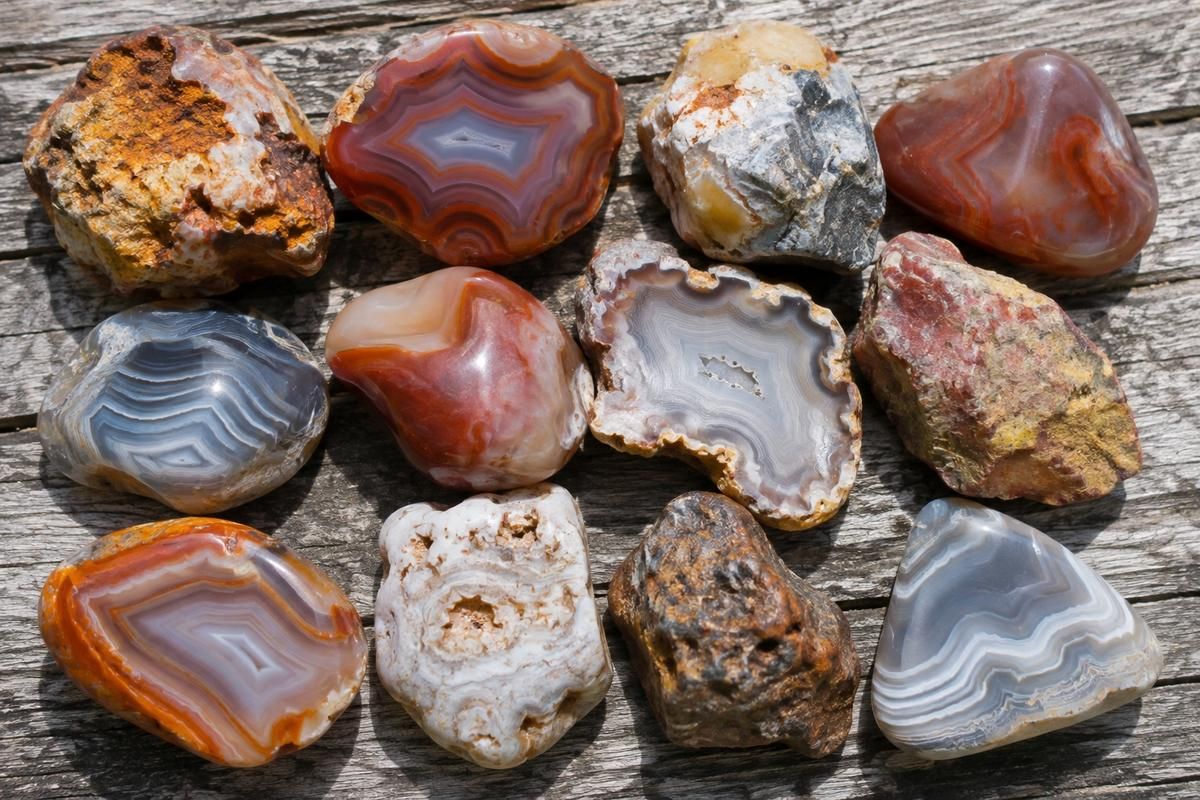
Agate is a banded, see-through form of quartz, and its types are named in three ways: by the pattern inside the stone (fortification, moss, plume, eye), by the place it comes from (Lake Superior, Botswana, Fairburn), or by a trade name a seller made up. The quickest way to tell a real agate in the field is to shine a light through it. Agate lets light pass and has a waxy shine, while look-alikes such as jasper and most ordinary rocks stay dark.
Field to Polish is a participant in the Amazon Services LLC Associates Program, an affiliate advertising program designed to provide a means for sites to earn advertising fees by advertising and linking to Amazon.com.
This guide explains what agate is, how it differs from jasper and chalcedony, and the main types, sorted by pattern and location. It then covers how to identify agate on a beach or gravel bar, how to spot dyed stones, where to look in the United States, and the rules for collecting. The facts come from state geological agencies, geology references, and federal land agencies, named in each section. We have not visited every location ourselves.
In This Guide
What Is Agate?
Agate is a type of chalcedony, which is quartz made of crystals far too small to see. What makes agate special is its bands. Minerals.net describes agate as the banded form of chalcedony, made of silicon dioxide, the same chemical as clear quartz crystal.
Most agates start as holes in rock. Geology.com explains that agate generally forms when groundwater carrying silica seeps into cavities in volcanic rock and leaves behind layer after layer. Each band records a change in the water. Over time, the layers fill the hole from the outside in, or settle flat from the bottom up. When the softer rock around them wears away, the hard agate nodules are left behind in soil, gravel, and riverbeds.
| Property | Agate |
|---|---|
| Mineral family | Chalcedony (microcrystalline quartz) |
| Chemistry | Silicon dioxide (SiO2) |
| Hardness | 7 on the Mohs scale |
| Specific gravity | 2.6 to 2.7 |
| Light | Translucent, so light passes through, although some are nearly opaque |
| Breaks with | Smooth, curved, shell-like edges (conchoidal fracture) |
| Luster | Glassy to waxy |
Properties from Minerals.net and Geology.com.
Agate vs Jasper vs Chalcedony
These three names trip up almost every new rockhound, because they are all the same basic material. FossilEra, a fossil and mineral dealer, sums it up well. Chalcedony is the umbrella term for microcrystalline quartz. Agate is chalcedony that lets light through. Jasper is chalcedony with so many impurities that light cannot pass through, making it opaque.
| Stone | What it is | Light test | Bands? |
|---|---|---|---|
| Chalcedony | The family name for microcrystalline quartz | Usually translucent | Often plain |
| Agate | Translucent chalcedony, usually banded | Glows when lit from behind | Usually |
| Jasper | Chalcedony packed with impurities | Stays dark | Sometimes, but opaque |
| Carnelian | Red to orange chalcedony colored by iron | Glows orange | Often plain |
| Onyx | Chalcedony with straight, parallel bands | Translucent bands | Yes, in straight lines |
A single rock can be both. FossilEra notes that parts of one stone can be translucent agate while other parts are opaque jasper. It also warns that much of the “onyx” sold in shops is really banded calcite, a softer carbonate mineral and not chalcedony at all.
How Agate Types Get Their Names
Agate names can feel random until you notice there are three kinds:
- Pattern names describe what you see inside, such as fortification, moss, plume, or eye. These can turn up anywhere in the world.
- Place names tell you where the stone was found, such as Lake Superior, Botswana, or Fairburn. A place name says nothing about the pattern, although stones from one area often look alike.
- Trade names are labels sellers use, such as crazy lace. Some are well established. Others are marketing, and a few are given to dyed or treated stones.
This is why one stone can carry two names. A Lake Superior agate can also be a fortification agate. It also explains why some “agates” are not true agates. Minerals.net notes that dendritic agate lacks banding, and Geology In says the same of moss agate, yet both names are used everywhere.
Types of Agate by Pattern
These pattern types are the ones rockhounds and lapidary hobbyists use most. Descriptions are drawn from Minerals.net, Geology In, and Geology.com.
Fortification agate
The classic agate. Its bands follow the shape of the original cavity and meet at sharp angles, so a cut slice looks like the walls and moats of a fort from above. Fairburn agates are famous for it, and the concentric bands of many Lake Superior agates follow the same pattern.
Water-line agate and onyx
Here the bands are flat and straight instead of curved. Geology.com explains that layers can settle horizontally from the floor of a cavity, much like water in a glass. Straight banded chalcedony in alternating colors is called onyx, and sardonyx when some bands are red, according to Geology In. Many stones show both curved fortification bands and flat water-line layers in the same piece, which shows which way was down when the stone formed.
Eye agate
Eye agates show small, round sets of rings that look like eyes, usually on the outside surface of a nodule. Because the rings are on the surface, you can sometimes spot an eye agate without cutting it.
Iris agate
Iris agate shows a rainbow of color when a thin slice is held up to a light. Minerals.net calls it rare. The effect only shows in thin, polished slices, so you will not see it in a rough stone.
Moss agate
Clear to milky chalcedony with green, black, or brown growths inside that look like moss or tiny plants. Geology In points out that moss agate is not a true agate because it lacks banding. The “moss” is made of mineral deposits, not plants.
Dendritic agate
Similar to moss agate, but the inclusions look like trees or ferns drawn in ink. Minerals.net also lists it as not a true agate because it has no bands.
Plume agate
Plume agate holds feather- or smoke-shaped inclusions. Geology In says they form when iron oxides are deposited in a way that looks like feathers or smoke. Plume agate is usually cut into slabs so the plumes show.
Tube agate
Tube agate has small tube shapes running through translucent chalcedony.
Sagenite agate
Sagenite agate contains thin, needle-like mineral crystals, often in fans or sunbursts. Geology In says the needles are mostly rutile.
Lace agate
Lace agates have wavy, twisting bands. Crazy lace, from Mexico, according to Geology.com, swirls in white, cream, brown, black, and gray. Blue lace agate, as Minerals.net describes it, has light blue bands in a lacy or wavy pattern.
Famous Agates by Place
Some agates are known by where they come from. These are the ones collectors ask about most.
| Agate | Where it comes from | What it looks like |
|---|---|---|
| Lake Superior agate | Minnesota, Wisconsin, and Michigan, around Lake Superior | Rusty red, orange, and yellow bands from iron. Minnesota’s state gemstone. |
| Montana agate | Yellowstone River gravels in southeastern Montana | Clear to orange-brown with black moss-like dendrites. One of Montana’s state gems. |
| Fairburn agate | Southwestern South Dakota and northwestern Nebraska | Tight, sharp fortification bands in many colors. South Dakota’s state gemstone. |
| Prairie agate | Nebraska | Nebraska’s state rock. |
| Botswana agate | Botswana, in southern Africa | Fine, parallel bands in white, purple, or peach. |
| Crazy lace agate | Mexico | Swirling, lacy bands in white, cream, brown, black, and gray. |
| Laguna agate | Chihuahua, Mexico | Red and scarlet tones with tight banding. |
| Condor agate | Northern Argentina, near the Rio Condor | Bright, busy banding. |
| Fire agate | Arizona, California, New Mexico, and Mexico | Brown agate with flashes of rainbow color. |
Sources: Minnesota DNR, Geology.com, Wikipedia’s list of state symbols and its Fairburn agate entry, Minerals.net, and Geology In.
Lake Superior agate
The Minnesota Department of Natural Resources tells the story well. More than a billion years ago, iron-rich lava flows formed around what is now Lake Superior. Gas bubbles in the lava filled with groundwater carrying iron and silica, which slowly built up bands of chalcedony. Glaciers later broke the agates free and spread them across northeastern and central Minnesota and far northwestern Wisconsin. Minnesota made it the state gemstone in 1969.
Most of the original gas pockets were about the size of a pea, so most finds are small. The Minnesota DNR says a few weigh more than 20 pounds, and only about 1 in 10,000 is an “all-timer” of 2 pounds or more with perfect shape, color, and banding.
Montana moss agate
Geology.com describes Montana agate as clear to orange to brown, with black mossy inclusions thought to be manganese oxide. It is found in the gravels of the Yellowstone River and its tributaries in southeastern Montana, where the hard nodules collect after the softer rock around them weathers away. Montana named agate and sapphire as its state gemstones in 1969.
Fairburn agate
Named for the town of Fairburn, South Dakota, this agate is known for very tight fortification banding in brown, red, orange, yellow, black, and white. It is found in southwestern South Dakota and northwestern Nebraska and was named South Dakota’s state gemstone in 1966.
Fire agate
Fire agate looks like a plain brown stone until light catches it. Geology.com explains that the color is thought to come from very thin layers coated with goethite, an iron mineral, which bend and reflect light like an oil film. It has been found in Arizona, California, New Mexico, and several Mexican states. Each stone is shaped by hand to show off its color, usually as a rounded cabochon.
Agate Types at a Glance
| Type | Look for | True banded agate? | Good for tumbling? |
|---|---|---|---|
| Fortification | Angled bands that follow the cavity walls | Yes | Yes, bands show after polishing |
| Water-line or onyx | Straight, flat bands | Yes | Yes |
| Eye | Small ring patterns on the surface | Yes | Yes, eyes stay visible |
| Iris | Rainbow color in thin, backlit slices | Yes | No, the effect needs thin slices |
| Moss | Plant-like inclusions in clear stone | No, lacks bands | Yes |
| Dendritic | Tree or fern shapes | No, lacks bands | Yes |
| Plume | Feather or smoke shapes | Varies | Better slabbed and polished |
| Lace | Wavy, swirling bands | Yes | Yes |
| Fire | Rainbow flashes under a brown surface | Yes | No, the color needs careful hand cutting |
The tumbling column is our own guidance, based on how each pattern shows. Agate is hard (7 on the Mohs scale) and polishes to a high shine, which is why it is a favorite tumbling rock. Our guide to the best rocks for tumbling explains why, and how to tumble rocks walks through each stage.
How to Identify an Agate in the Field
Agates on a beach or gravel bar rarely look like the polished slices in shops. The bands are often hidden under a rough, stained skin. The Minnesota DNR lists five clues that work for Lake Superior agates and help with most others:
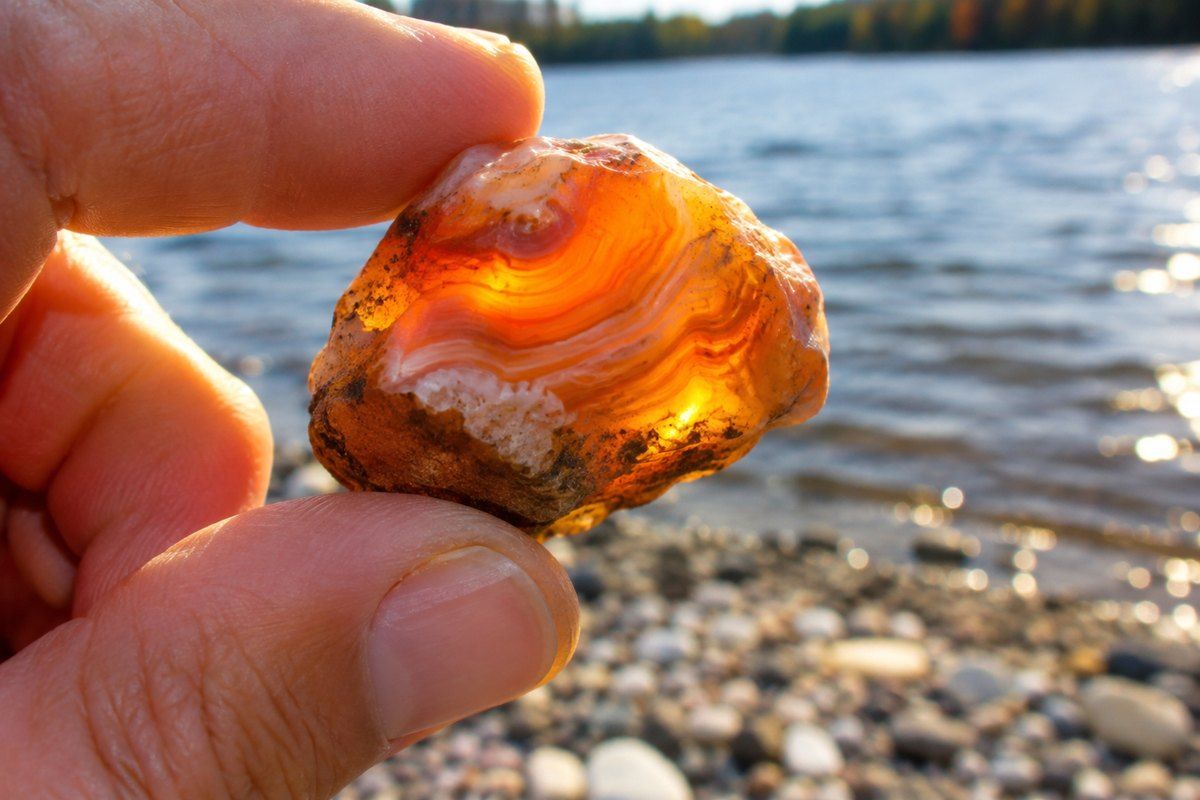
- Light passes through. Chalcedony is translucent, so an agate glows when the sun is behind it. This is the single best test.
- A waxy shine. Look at any chipped or broken spot. Agate has a waxy or glossy luster there, unlike the dull, grainy break of most rocks.
- Iron staining. Nearly all Lake Superior agates have some rusty red or yellow staining.
- A peeled look. Where an agate has broken along its bands, the surface can look like a partly peeled banana skin.
- Small pits. The outside is often dotted with small dents left by the walls of the original gas bubble.
Then confirm it with these checks:
- The flashlight test. Press a bright LED flashlight against the stone in the shade. Agate and other chalcedony glow. Jasper, basalt, and granite stay dark. Wet the stone first, since water makes bands and translucence easier to see.
- Look for bands with a loupe. A 10x hand lens shows faint banding at the edges of a chip.
- Check the break. Agate breaks with smooth, curved, shell-like edges.
- Hardness. Agate rates 7 on the Mohs scale, harder than window glass, so a sharp edge will scratch glass. Test on a scrap piece of glass, not a window.
Common look-alikes include jasper (opaque), quartz pebbles (clear or white but with no bands and a glassier shine), and chert or flint (often dull and grainy where broken). Some agates are so stained or weathered that only cutting will tell you. If a stone passes the light test, keep it.
How to Spot Dyed or Fake Agate
Natural agate colors are mostly earthy: white, gray, tan, brown, red, orange, and yellow, with soft blues in some. Geology.com explains that agate is porous and takes dye easily, and that most of the brightly colored agate in the gem trade has been dyed. Minerals.net adds that bright neon colors such as blue and red are rarely natural.
- Colors that look unreal. Electric blue, purple, hot pink, or bright green slices are almost always dyed.
- Color that sits in the bands. Dye soaks into the more porous bands, so it often looks too even or follows the bands with sharp edges.
- Same color, many slices. A display of identical neon geode slices or bookends points to dye.
- “Onyx” that is soft. FossilEra notes that much shop “onyx” is banded calcite. Calcite is much softer than agate and fizzes in vinegar, while agate does not.
Dyed agate is not a scam if it is labeled as dyed. The problem is when it is sold as natural. If you collect your own, you never have to wonder.
Where to Find Agates in the United States
Agates form in volcanic rock and then end up wherever water and ice carry them. Geology In notes that most agates form as nodules in volcanic rock or old lava flows. Good places to search share a few features:
- Gravel. River gravel bars, gravel pits, road cuts, and glacial gravel. The Minnesota DNR says any place with exposed gravel and rocks is worth checking.
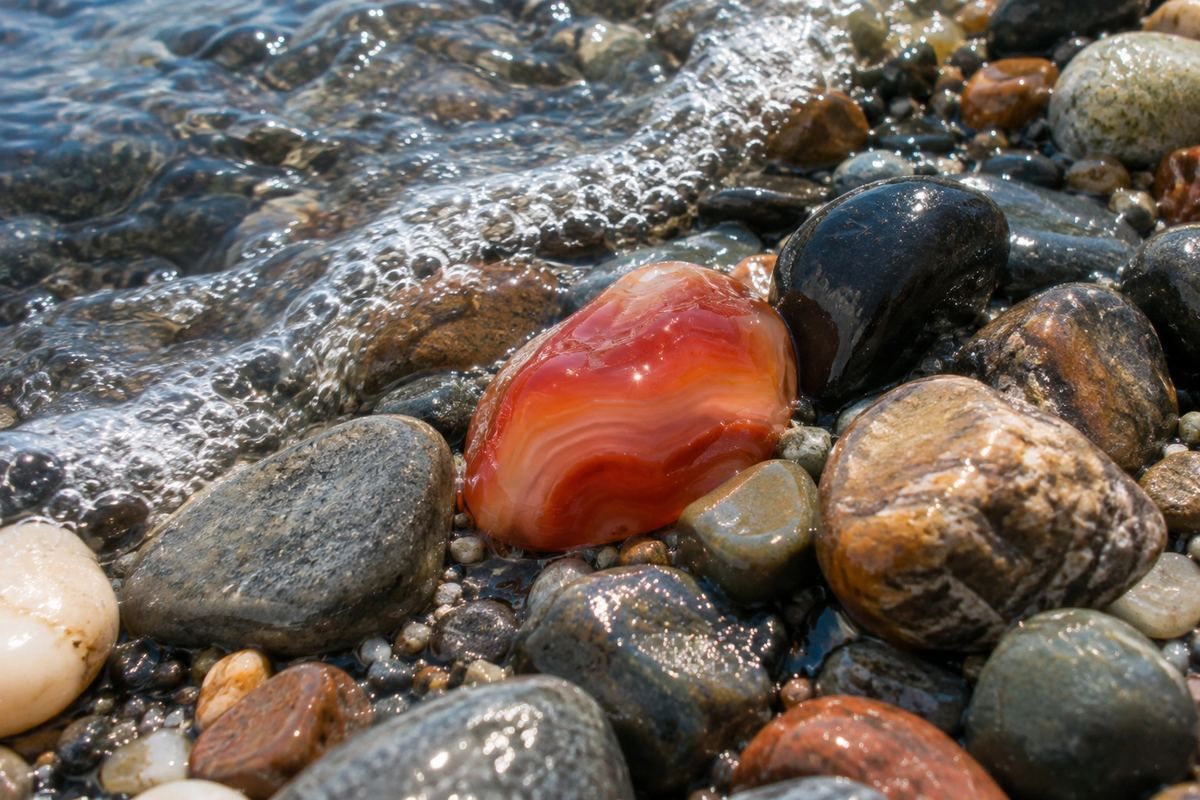
- Beaches. Lake and ocean shores where waves wash and sort the stones, especially after storms.
- Rivers that drain volcanic country. Montana’s Yellowstone River is the best-known example.
- Desert and badlands. Wind and rain leave hard agates lying on the surface as softer rock wears away.
Seven states have named an agate as an official state symbol, which is a good hint about where agates are found:
| State | Symbol | Year |
|---|---|---|
| South Dakota | Fairburn agate, state gemstone | 1966 |
| Nebraska | Prairie agate, state rock | 1967 |
| Minnesota | Lake Superior agate, state gemstone | 1969 |
| Montana | Montana agate, state gemstone (with sapphire) | 1969 |
| Kentucky | Kentucky agate, state rock | 2000 |
| Tennessee | Agate, state mineral | 2009 |
| Louisiana | Agate, state mineral | 2011 |
From Wikipedia’s list of U.S. state minerals, rocks, stones and gemstones.
Agates also turn up in many other western states with volcanic rock, including the beaches of the Pacific Northwest. Local rock clubs are the best source for current, legal sites near you. Our rockhounding for beginners guide covers how to find them.
Rules for Collecting Agates
The landowner decides whether you can pick up a stone. A few rules apply almost everywhere in the United States:
- National parks: no. The National Park Service says random mineral collection in national parks is prohibited.
- Bureau of Land Management (BLM) land: usually yes, in small amounts. A BLM recreational rockhounding guide allows casual collecting for personal use, in reasonable amounts, with hand tools, as long as the area is not closed. Selling what you collect or using powered equipment is not casual collecting.
- Mining claims. The BLM notes that minerals on an active mining claim can belong to the claim holder. Look for claim markers and ask first.
- Private land. Always get the owner’s permission.
- State parks and beaches. Rules vary by state and park. Check with the park before you collect.
Fill any holes you dig, take only what you will use, and leave the rest for the next person.
Gear for Agate Hunting
You do not need much. A good light and a hand lens do most of the work.
Gear for this guide4 items
Light test
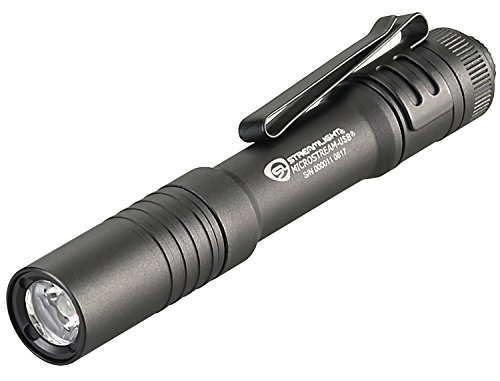
Streamlight MicroStream 250 lumen flashlight
Small enough for a pocket and bright enough to light up a stone
Check Price on Amazon
Looking for bands
Ade Advanced Optics 10x triplet loupe
Shows faint bands and the edges of chips
Check Price on Amazon
Breaking matrix
Estwing E3-22P rock pick
For digging in gravel and cracking open host rock
Check Price on Amazon
Eye protection
3M SecureFit 400 safety glasses
Wear them whenever you strike rock
Check Price on AmazonFor a full kit list, see our rockhounding tools guide and our rock hammer guide.
Common Mistakes When Hunting Agates
- Looking for shop-style colors. Natural agates are mostly earthy reds, browns, and whites, and the bands often hide under a rough skin.
- Hunting on cloudy days. Translucence is the best clue, and it shows best in sunlight. Low sun behind the stones helps.
- Searching dry stones only. Wet stones show color and translucence better. Search right after a wave or carry a spray bottle.
- Breaking every stone to check it. Use the light test first. A broken agate loses value and is harder to tumble well.
- Collecting where it is not allowed. Check the land rules before you go.
- Assuming bright colors mean a good find. In shops, bright often means dyed.
Agate Questions
Is agate a type of quartz?
Yes. Agate is a banded form of chalcedony, which is quartz made of crystals too small to see. It has the same chemistry as clear quartz (silicon dioxide) and the same hardness of 7.
What is the difference between agate and jasper?
Agate lets light through, while jasper is opaque. Both are forms of chalcedony. Jasper contains so many impurities that light cannot pass through, and one stone can contain both.
How can I tell if a rock is an agate?
Shine a bright flashlight through it. Agate glows, while most other rocks stay dark. Also look for a waxy shine on chipped spots, faint bands, iron staining, and small pits on the surface.
What is the rarest type of agate?
Rarity depends more on the place and the quality than on the name. Iris agate and fire agate are uncommon, and among Lake Superior agates, the Minnesota DNR says only about 1 in 10,000 is a large, perfectly banded all-timer.
Is moss agate a real agate?
Not strictly. Moss agate is chalcedony with plant-like mineral inclusions, but it lacks the banding that defines true agate. The name is still used everywhere.
What is the difference between an agate and a geode?
A geode is a hollow cavity lined with crystals. An agate forms when silica fills a cavity with bands, often all the way. Some geodes have an agate rind with crystals in the middle.
Where is the best place to find agates?
Gravel bars, beaches, and rivers in areas with old volcanic rock. In the United States, the Lake Superior region, Montana’s Yellowstone River, and the plains of South Dakota and Nebraska are best known.
How do you clean agates you find?
Soak them in water and scrub with a soft brush and a little dish soap. Agate handles most cleaners, but iron stains are part of the look on many agates, so test any stain remover on one stone first.
Can you tumble agates in a rock tumbler?
Yes. Agate is hard and takes a high polish, which makes it one of the most popular rocks for tumbling. Tumble agates with other stones of the same hardness.
The Bottom Line
Agate is banded, translucent chalcedony, and its many names come from its pattern, the place it was found, or a seller’s label. To find your own, search gravel and beaches in agate country, hold stones up to the light, and look for a waxy shine, iron staining, and pitted skin. Skip neon colors in shops unless they are labeled as dyed, and check the land rules before you collect. When you bring your finds home, see how to clean rocks, then tumble them or polish them by hand. Found a round rock with crystals inside instead? Read where to find geodes and how to open a geode.