
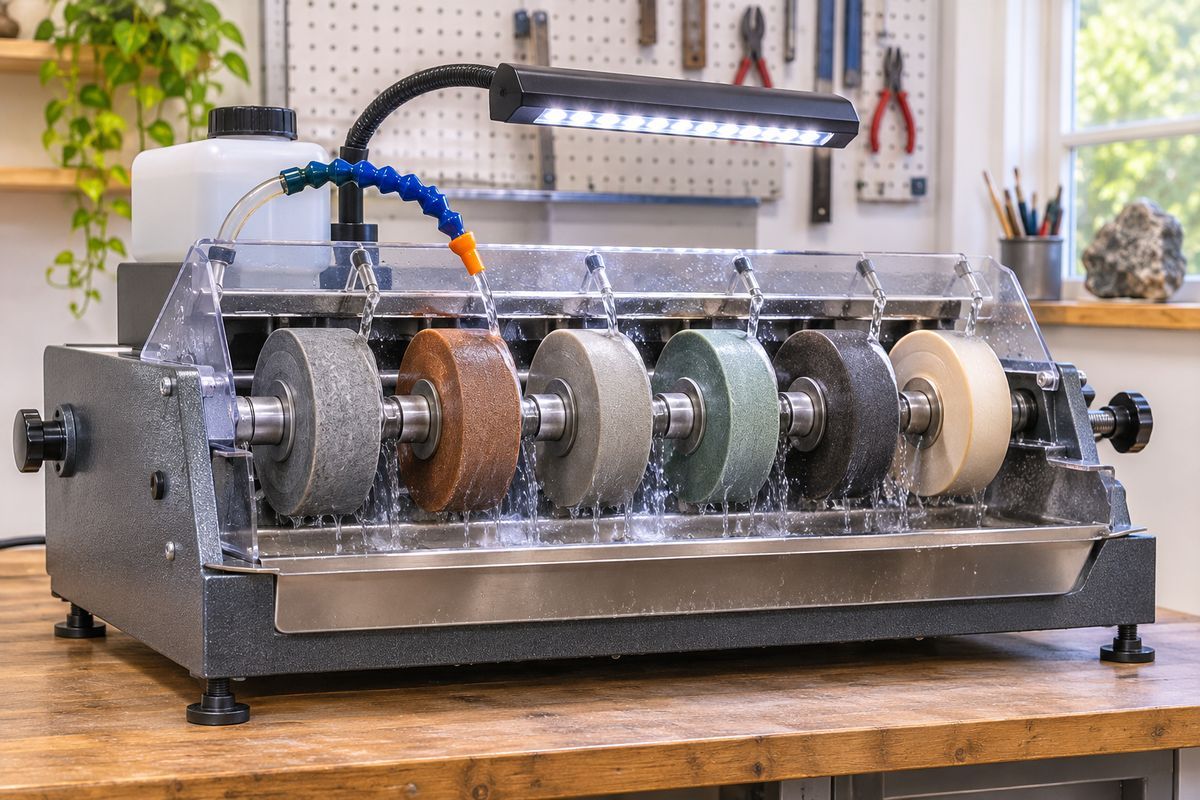
A cabbing machine grinds and polishes a piece of rough stone into a cabochon, a smooth, dome-shaped stone used in rings, pendants, and other jewelry. If you already cut slabs with a lapidary saw or tumble rocks for fun, a cabbing machine is the next step up. It lets you shape one stone at a time with real control, instead of leaving the shape to chance in a tumbler barrel.
This guide covers what it does, the difference between a 6-inch and an 8-inch machine, what to check before you buy, and a few machines worth considering for beginners and step-up users.
In This Guide
At a GlanceCompare before you read the full reviews
→ Scroll sideways on a small screen to see every column
| Machine | Best For | Biggest Drawback | What’s Included | Motor | Water System |
|---|---|---|---|---|---|
| CabKing 6-Inch | Most beginners | No built-in saw included (CabKing sells an optional trim-saw attachment); only 3/4 inch of wheel spacing | 6 wheels + 360# lap + canvas polishing pad, water pump, splash guards, apron, goggles | 1/4 HP direct drive, 1,800 RPM, 352W/3.2A at 110V (220V export version available) | Single-pass, separate 30W pump |
| VEVOR 6-Inch (2/5 HP) | Budget pick that also wants built-in cutting | Not a lapidary specialist brand; newer to market with a shorter track record than CabKing | 6 wheels + diamond lap, saw-cutting + side-polishing modules, LED light, water pump | 2/5 HP direct drive, 1,800 RPM | Independent per-wheel water flow control |
| CabKing 8-Inch | Stepping up to larger stones | Needs a 2 by 4 foot bench and a two-person setup; heavier and pricier than either 6-inch option | 6 wheels + 360# lap + 6″ canvas pad, polishing accessory kit, goggles, apron | 3/4 HP direct drive, 1,800 RPM, 110 to 115V (220V export version available) | Adjustable, independently controlled drip-feed cooling |
Prices change often and this site does not quote Amazon prices in the text; check the current price on each product’s listing page. Scroll the table sideways on a small screen to see every column.
What a Cabbing Machine Does (and What a Cabochon Is)
A cabochon, often shortened to “cab,” is a stone ground into a smooth, rounded shape and polished to a shine, with no facets cut into it. Agates, jaspers, and many other rocks that tumble well also make good cabochons, since the same basic idea applies: grind away the rough outer layer, then polish what is left.
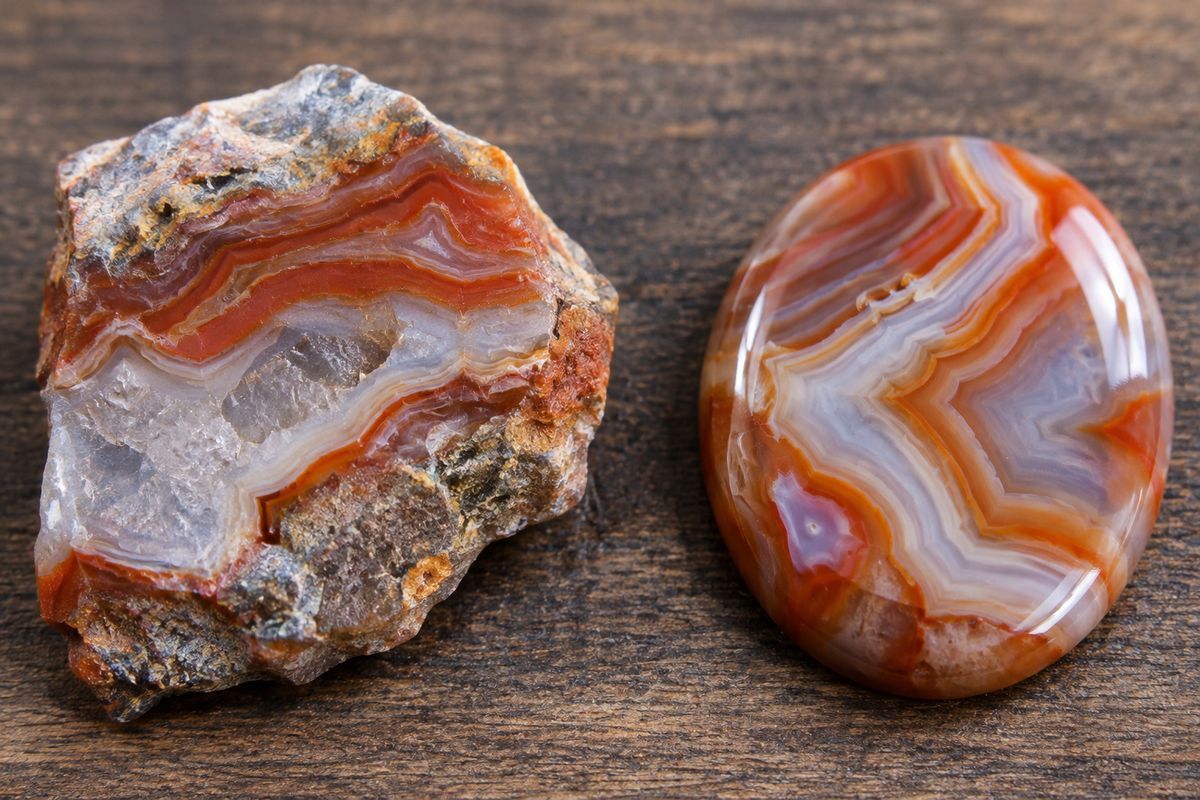
This happens with a set of spinning diamond wheels, usually four to six, mounted on a shaft. Each wheel is a little finer than the one before it. You start on a coarse wheel to shape the stone, move through progressively finer wheels, and finish on a polishing wheel or pad. Water flows over each wheel the whole time, keeping the stone cool and washing away the grit as you work.
This is different from a rock tumbler. A tumbler polishes a whole batch of rocks at once, but you cannot control the shape. It lets you choose the exact outline and dome of one stone, which is why jewelry makers use them instead of a tumbler for cabochons.
6-Inch vs 8-Inch: Which Size to Start With
Cabbing machines mostly come in two wheel sizes: 6-inch and 8-inch. The number refers to the diameter of each grinding and polishing wheel.
A 6-inch machine is the standard starting point. The wheels are smaller, the machine takes up less bench space, and it costs less to buy and to replace wheels later. It handles the stone sizes most beginners work with without any trouble.
An 8-inch machine has more room between the wheels and a stronger motor, usually 3/4 horsepower against 1/4 horsepower on most 6-inch models. That extra space matters most once you are shaping larger cabs or working with thicker material, where a 6-inch wheel’s limited clearance gets in the way. For a first machine, most lapidary guides and forum threads point beginners toward 6-inch, and save 8-inch for later once you know you will stick with the hobby.
Beyond space and cost, a few other differences are worth weighing. An 8-inch machine’s larger wheels and motor run a bit louder than a 6-inch unit, which matters if you are working in a shared space like a garage with other people in the house. More wheel surface and a stronger motor also mean more splash and slurry to rinse off and wipe down after each session, so cleanup takes a little longer. None of this adds real difficulty to learning the actual cabbing technique itself, which is the same on either size: the learning curve is about practicing grit progression and dome shaping, not about which machine you start on.
What to Look For Before You Buy
A few things matter more than brand name when you are comparing cabbing machines.
Motor power and speed. Most beginner machines run a direct-drive motor at 1800 RPM, with horsepower ranging from about 1/4 HP on compact 6-inch units up to 3/4 HP on larger 8-inch machines. More power mostly matters for cutting through harder, denser stone faster, not for the final polish.
Wheel count and grit progression. Look for at least four wheels, moving from a coarse grinding grit (around 80 to 100) through medium grits and up to a fine polishing grit (1200 or higher), plus a separate polishing pad or lap for the final shine. A machine with only two or three wheels leaves gaps in the grit progression, making it harder to get a clean finish.
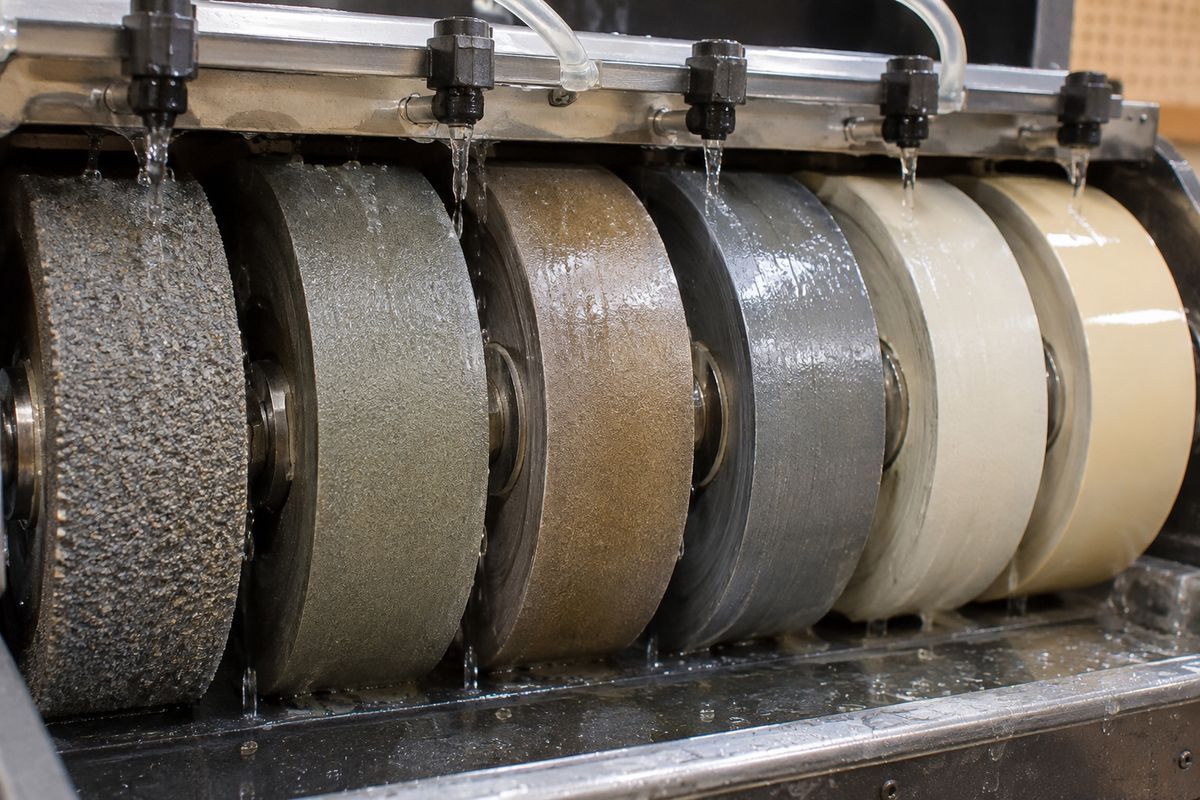
Water system. Every wheel needs its own water feed, both to keep the stone cool and to wash the ground-off material away as you work. A system that lets you control water flow to each wheel on its own, rather than one shared line, keeps the mess down and makes cleanup easier.
What is included. Beginner kits typically include the wheels themselves, a water pump, splash guards, hand rests, safety goggles, and some kind of apron. Checking this list against the price matters, since a bare machine with no accessories can end up costing more once you buy everything separately.
Footprint and setup. A 6-inch machine needs roughly a 2-by-3-foot area on a sturdy table. Plan for a nearby water source or at least two buckets, one for clean water and one to catch the runoff, since most of these machines use a single-pass water system rather than a recirculating one.
Realistic starting cost. The machine’s price is rarely the whole cost. Budget for a few things beyond it: rough stone or pre-cut slabs to practice on, dop wax or a dopping adhesive to hold small stones while you grind, a grit/polish refresher kit for when the included wheels wear down, and a bit of bench space you are comfortable getting wet. The three machines above already include goggles, an apron, and splash guards, which keeps the add-on list shorter than it would be for a bare machine.
Included vs. optional. All three machines above ship with their full wheel set, water pump, splash guards, and basic safety gear (goggles, an apron) as standard. Some features that look similar on paper are not: CabKing’s trim-saw attachment for the 6-inch and 8-inch machines is an official accessory that bolts onto the machine, but it is sold separately and is not in the base box, while VEVOR’s saw-cutting and side-polishing modules ship already installed with the specific listing reviewed here. Worth checking for any machine you are comparing: which accessories are already in the box versus which ones you would add later as a separate purchase.
Replacement-wheel cost. Once the included wheels wear down, a full replacement wheel set (all six wheels) typically runs about a quarter to a third of the machine’s price, based on current listings from CabKing’s parts store and major lapidary suppliers. You do not have to replace the whole set at once: most suppliers also sell individual wheels, which is worth doing if only your coarsest grinding wheel or finest polishing wheel has worn down unevenly. Wheel and lap prices move more often than the machine’s own price, so check current listings before budgeting an exact figure.
Cabbing Machines Worth Considering
We chose these from their Amazon listings, checked on November 21, 2026. We have not tested them.
Pick 01Best for most beginners
CabKing 6-Inch Cabbing Machine

The CabKing 6-Inch is one of the most common cabbing machines for people just getting started, and it comes close to being ready to run. The kit includes six wheels (two diamond grinding wheels and four resin polishing wheels), a polishing pad, a water pump, splash guards, hand rests, goggles, and an apron, so there is little left to buy separately. It runs a 1/4 HP direct-drive motor at a single 1,800 RPM speed, rated by CabKing’s own FAQ at 352 watts and 3.2 amps at 110V, and the water system lets you adjust flow to each wheel.
It arrives mostly assembled, and setup takes under an hour for one person. One thing to check before buying: the standard version sold in the US runs on 110 to 115V power only. CabKing also sells a 220V export version of this same machine for buyers outside North America, so if you are ordering from outside the US, confirm you are getting that version rather than the US one.
Verdict: a solid, well-documented first machine from a brand that specializes only in cabbing machines, with the widest base of independent manuals and parts support of the three picks here.
What’s included: 2 electroplated diamond wheels (80#, 220#), 4 diamond resin wheels (280#, 600#, 1,200#, 3,000#), a 360# full-face diamond lap, a canvas polishing pad with diamond paste, removable trays, hand rests, splash guards, a waterproof apron, and safety goggles.
Setup needs: Arrives mostly assembled; a single person can typically get it set up and running in under an hour, following CabKing’s own instruction manual.
- Six wheels plus a lap and polishing pad cover the full rough-to-polish process out of the box
- Single-pass water system is simple to maintain, with no recirculating pump to clean out
- CabKing specializes in cabbing machines, so parts, wheel sets, and manuals are easy to find later
- No built-in saw or side-polishing attachment included in the box, though CabKing sells an official optional trim-saw attachment sized for this machine
- Water splash and slurry cleanup take a bit of getting used to on a single-pass system
- Only 3/4 inch of wheel spacing, which limits how large a stone you can comfortably work with
Maintenance and consumables: Replacement wheels, the full-face lap, and the canvas polishing pad are sold individually by CabKing and third-party lapidary suppliers as they wear down; the water pump is a standard, separately replaceable submersible unit.
Biggest drawback: If you plan to work larger stones, you will outgrow the 3/4 inch wheel spacing faster than with the other two picks. If you want to add cutting later, CabKing sells an optional trim-saw attachment built for this machine rather than requiring a separate stand-alone saw.
Pick 02Budget pick
VEVOR 6-Inch Cabbing Machine

VEVOR’s 6-Inch machine is a lower-cost alternative that still covers the basics: six diamond and resin wheels, a water pump, an LED work light, and a 2/5 HP direct-drive motor rated at 1,800 RPM. This specific listing also includes a saw-cutting module and a side-polishing attachment, features the base CabKing 6-inch does not include.
VEVOR sells several cabbing machine variants under the same general name with different motor ratings, so this review applies to this exact listing rather than every VEVOR cabbing machine on Amazon. It is a reasonable way to try the hobby without the larger upfront cost of a CabKing, though VEVOR is not a lapidary specialist brand the way CabKing is, and its machines are generally newer to the market with less of a long-term track record.
Verdict: a lower-cost way to get into cabbing that also throws in cutting and side-polishing accessories the base CabKing 6-inch does not include, from a brand better known for general tools than lapidary specifically.
What’s included: 2 diamond wheels, 4 resin wheels, a separate diamond lap, an LED work light, a side-polishing module, a saw-cutting module, 2 open-end wrenches, and an instruction guide.
Setup needs: VEVOR’s own listing does not break out an exact setup time; expect it to be broadly similar to the CabKing 6-inch, roughly an hour for one person, since the overall layout is similar.
- Comes with a saw-cutting module and side-polishing attachment included, rather than as separate purchases
- Independent per-wheel water flow control, so you can adjust flow to the wheel you are actually using
- Noticeably lower cost than either CabKing option for a buyer who is not sure the hobby will stick
- VEVOR sells several cabbing machines under the same general product name with different motor ratings, so it is easy to accidentally compare a different listing’s specs to this one
- Not a lapidary specialist brand, so there is less of a long-term track record and fewer independent repair guides than for CabKing
- VEVOR’s own Amazon listing’s customer review section does not appear to match this product (it currently shows reviews describing an unrelated rock tumbler), so there is no reliable customer feedback to point to for this specific listing
Maintenance and consumables: Replacement wheels and the diamond lap are sold separately through VEVOR’s own storefront and general lapidary suppliers; because this model includes a saw-cutting module, you will also need to budget for saw blade replacements over time.
Biggest drawback: The mismatched reviews on its own Amazon listing mean you cannot currently lean on verified customer feedback for this exact product, something you can rely on with the more established CabKing line.
Pick 03Best for stepping up to larger stones
CabKing 8-Inch Cabbing Machine

For anyone ready to size up, the CabKing 8-Inch keeps the same basic layout as the 6-inch version but with larger wheels, a 3/4 HP motor, and noticeably more room between wheels, about 2.5 inches of spacing against 3/4 inch on the 6-inch model. That extra clearance is the real reason to step up to 8-inch rather than the wheel size itself. It needs a larger bench footprint, roughly 2 by 4 feet, and setup is a two-person job.
Verdict: a step up in capacity and wheel spacing for someone who has outgrown a 6-inch machine or plans to work larger stones from the start, built by the same lapidary specialist as the 6-inch CabKing.
What’s included: 2 electroplated diamond wheels (80#, 220#), 4 diamond resin wheels (280#, 600#, 1,200#, 3,000#), one 8-inch 360# electroplated diamond lap, one 6-inch canvas polishing pad, and a polishing accessory kit (canvas disc, diamond paste, goggles, apron).
Setup needs: Heavier and larger than the 6-inch machines; CabKing’s own manual recommends two people for assembly and a sturdy bench with about 4 feet of width and 2 feet of depth of clear space.
- About 2.5 inches of wheel spacing versus 3/4 inch on the 6-inch models, so there is real room to work larger stones without fighting the machine
- Adjustable, independently controlled drip-feed water system drips clean water onto the wheels rather than recirculating dirty water
- Same manufacturer and parts ecosystem as the CabKing 6-inch, so manuals, wheel sets, and support are consistent if you already own one
- Needs a dedicated bench footprint of roughly 2 by 4 feet, more than most beginners have set aside for a first machine
- Two-person assembly recommended, and the fully assembled unit is a genuinely heavy, bench-mounted tool rather than something you can easily move
- CabKing’s own manual notes the enclosed motor housing can reach around 220°F during normal use, so plan for a cool-down period before handling it after a long session
Maintenance and consumables: Replacement wheels, the 360# lap, and the canvas pad are sold individually by CabKing and third-party lapidary suppliers; the motor is a sealed, non-ventilated unit with no user-serviceable parts inside.
Biggest drawback: The bench space and two-person setup are real commitments. If you are not already confident you want to keep cabbing as a hobby, start with a 6-inch machine instead.
Setting Up Your Cabbing Machine Safely
Cabbing is a wet process: water runs over the wheels the whole time you grind, which keeps most of the ground stone down as a slurry instead of airborne dust. That is a real and necessary precaution, but it does not guarantee zero exposure. Research on stone-grinding tasks, even under wet conditions, has measured respirable crystalline silica above safety limits in some settings, and the slurry itself only stays harmless while it is wet. Once it dries on the machine, a splash guard, or your hands, ordinary cleanup like wiping or sweeping can put that dust back into the air. A few habits are worth building from day one.
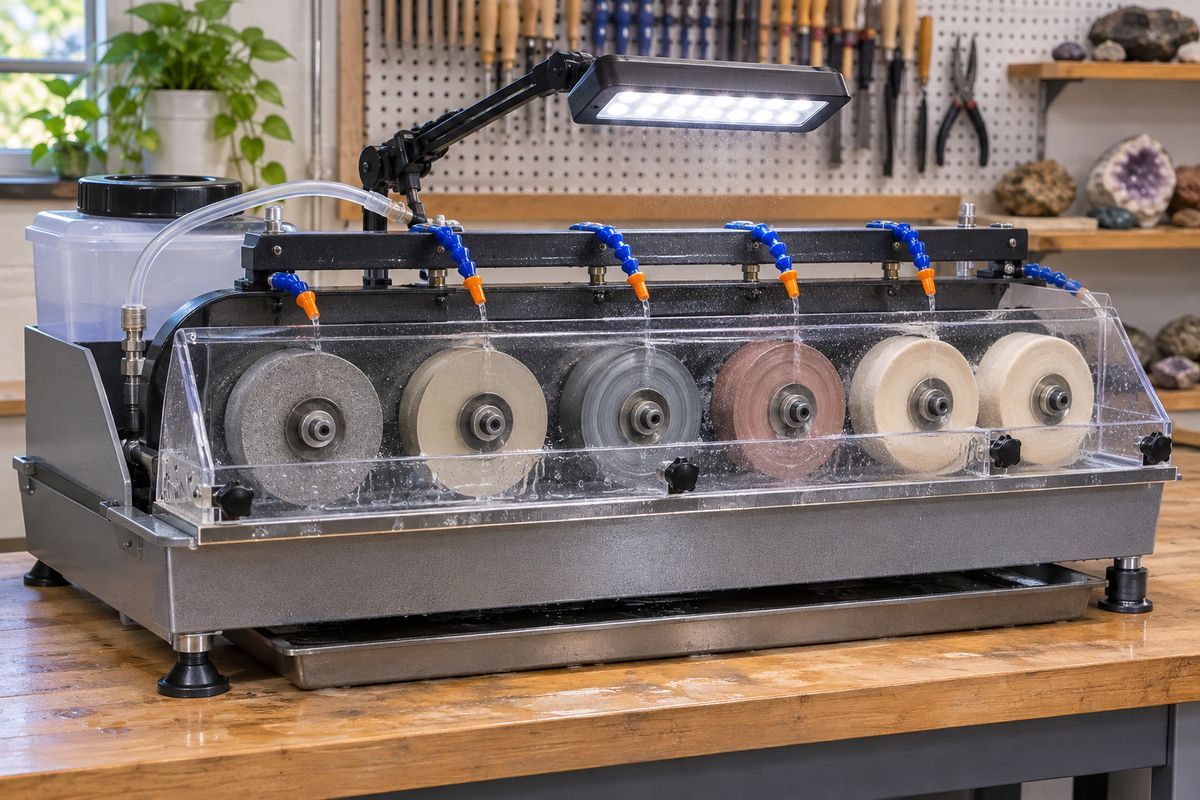
Wear splash-rated eye protection, such as the goggles that come with the machine, any time it is running, since both flying grit and water spray happen during normal grinding. Water running over the wheels helps control dust, but it is not a substitute for eye protection, and it does not mean the process is dust-free.
Clean up dried slurry with a damp cloth or by wet-wiping the area; never dry sweep or blow it off with compressed air, as both can put settled dust back into the air you breathe. Wipe down a splash guard or tray once it is dry, rather than letting residue cake up and get knocked loose later.
Because this is a corded electric tool running next to a water system, plug it into a GFCI-protected outlet or circuit, the same protection recommended for any power tool used near water, and keep the motor housing and power cord dry and routed away from the trays and drip lines.
If a stone chips or cracks while grinding, let the machine stop fully before you reach in to remove it. Keep long hair tied back and loose sleeves out of the way of the spinning wheels and shaft.
Dispose of the collected slurry in household trash rather than down a drain, since it contains ground stone and worn diamond or resin grit that can clog pipes over time.
Finally, read the full instruction manual before your first grinding session. Each brand sets up its water lines and wheel order a little differently, and that first read saves you from a slow start.
Common Mistakes Beginners Make
New cabbers tend to make the same handful of mistakes early on.
Skipping grit stages. Jumping from a coarse wheel straight to a fine polishing wheel leaves scratches that no amount of polishing will remove. Work through each wheel in order.
Using too little water. Not enough water on the wheel lets the stone heat up, which can crack some materials and wear down the diamond coating faster than it should.
Rushing the shaping stage. Most of a cab’s final look comes from the shape and dome you grind in before polishing. A rushed shaping stage shows up clearly once the stone is polished and there is no hiding it.
Choosing stone that is too soft or too fractured. Not every rock that looks pretty tumbles or cabs well. Stones with existing cracks tend to break apart partway through grinding, which wastes both the stone and your time.
Not sure which rocks are worth cabbing in the first place? Our guide to polishing rocks covers how to judge a stone before you commit it to the wheels.
Troubleshooting Common Problems
Even with careful technique, a few problems show up often enough that it helps to know the fix before you hit them.
Visible scratches after polishing. This almost always means a scratch from an earlier, coarser wheel never fully came out before you moved on. Go back one or two grit stages and re-work the area until the scratch is gone, then work forward through each finer wheel again rather than jumping straight back to polish.
Flat spots instead of an even dome. Flat spots come from holding the stone at a fixed angle for too long instead of rolling and rotating it against the wheel as you grind. Check the dome’s shape against a light source from multiple angles while you work, not just once at the end, and keep the stone moving in small rolling motions rather than resting it in one position.
The stone feels hot or starts to smell. This usually means too little water is reaching the wheel, either because the flow is turned down too far or a feed line has partly clogged with ground-off material. Stop, increase water flow or clear the feed line, and let the stone cool before continuing; grinding a hot, dry stone is also a safety issue, not just a quality one.
Slurry buildup making a mess mid-session. A thick gray film on the tray and wheels is normal while you work, but let it pile up and it both throws water out of the tray and dries into a fine dust the moment it is disturbed. Rinse the tray and splash guards every few wheel changes rather than waiting until the end of a session.
The stone keeps breaking or chipping apart. Some material is simply too fractured to cab successfully. If a stone keeps losing chunks at the same spot across more than one attempt, it likely has an internal crack or seam running through it; set it aside for tumbling or display rather than continuing to grind it down.
FAQ
What is a cabbing machine used for?
A cabbing machine grinds and polishes a piece of rough stone, glass, or similar material into a cabochon, a smooth domed shape used in jewelry like rings, pendants, and earrings.
Is a cabbing machine the same as a rock tumbler?
No. A tumbler polishes a batch of rocks at once with no control over the final shape. A cabbing machine lets you shape and polish one stone at a time with the exact outline you choose.
What size cabbing machine should a beginner buy?
Most beginners start with a 6-inch machine. It costs less, takes up less space, and handles the stone sizes most new cabbers work with. An 8-inch machine is worth considering later, once you are working with larger or thicker material.
Do I need any special safety gear?
Wear the safety goggles that come with the machine any time it is running, and plug it into a GFCI-protected outlet since this is a corded tool used next to a water system. The main risks are flying grit during grinding and dried silica dust kicked back up during cleanup, so wet-wipe slurry off the machine rather than dry-sweeping or blowing it off. Tie back long hair and keep loose sleeves away from the spinning wheels.
Can I use a cabbing machine on materials other than rock?
Yes. Most cabbing machines also grind and polish glass, synthetic materials, and some metals, though the grit progression and pressure you use may need to change depending on the material. The Mindat mineral database is a good place to look up hardness and other properties for a specific material before you try it.