
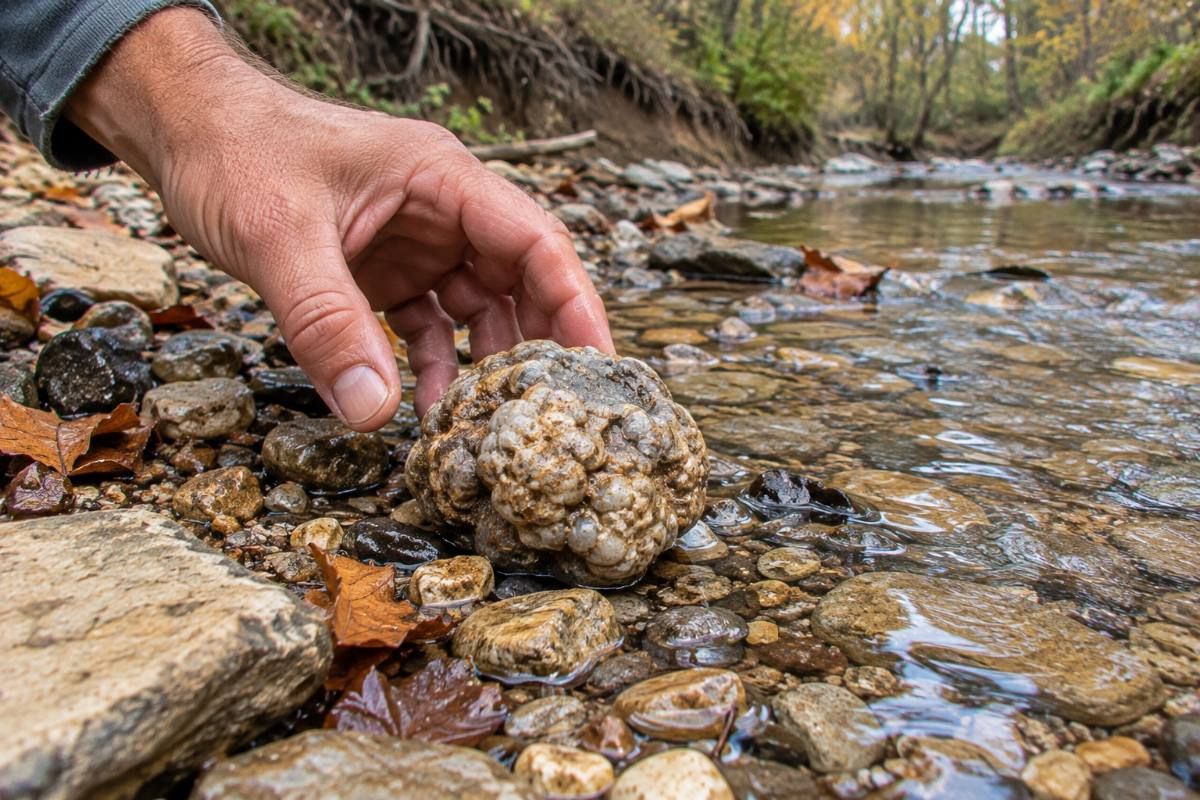
In the United States, geodes are found in two main kinds of places: limestone country in the Midwest, especially around Keokuk, Iowa, and volcanic desert in the West, such as Utah’s Dugway Geode Beds and California’s Hauser Geode Beds. Look in creek beds, road cuts, and eroded hillsides, where weathering wears the geodes out of the surrounding rock. Before you dig, find out who owns the land. Most state parks in geode country ban collecting, Bureau of Land Management (BLM) land usually allows small amounts for personal use, and most Midwest geode ground is private.
Field to Polish is a participant in the Amazon Services LLC Associates Program, an affiliate advertising program designed to provide a means for sites to earn advertising fees by advertising and linking to Amazon.com.
This guide explains why geodes form where they do, how to spot one, the best-known places to find geodes in the US, and the collecting rules at each. It draws on state geological surveys, the BLM, the US Forest Service, and state park agencies, and we checked location details on October 13, 2026. We have not visited these sites ourselves. Rules and road access change, so call the managing office before you go.
In This Guide
Where to Find Geodes: The Short Answer
| Region | Where to look | Who manages the land | Can you collect? |
|---|---|---|---|
| Keokuk region (Iowa, Illinois, Missouri) | Creek beds, road cuts, and hillsides within about 35 miles of Keokuk | Mostly private | With landowner permission or at sites that allow it. Not in Iowa state parks. |
| South-central Indiana | Road cuts, streams, and soil near Harrodsburg Limestone outcrops | Mostly private | With landowner permission |
| Southern Kentucky | Weathered ground, creek beds, and lake shorelines | Private land and Army Corps of Engineers lake land | On private land with permission. Not on Corps lake land without written permission. |
| Dugway Geode Beds, Utah | Old dig pits in volcanic deposits | BLM | Yes, in reasonable amounts for personal use |
| Hauser Geode Beds, California | Desert dig sites near Wiley’s Well | BLM | Yes, for recreation only |
| Central and eastern Oregon (thundereggs) | Forest Service collecting sites and Succor Creek | US Forest Service and Oregon State Parks | Yes at listed Forest Service sites. Limited at Succor Creek. |
Why Geodes Form Where They Do
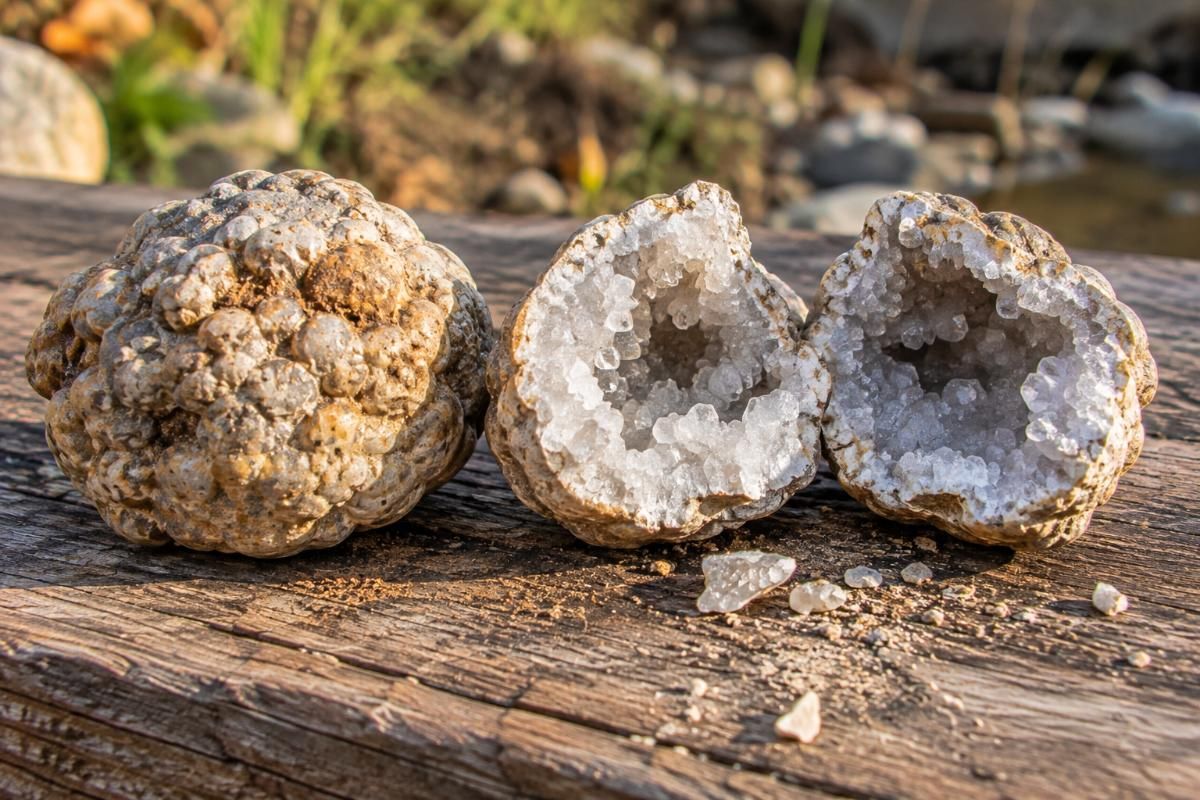
A geode is a rounded rock with a hollow center lined with crystals, usually quartz. Geodes are hollow rock nodules with a bumpy, cauliflower-like rind. Geodes form in two very different settings, which is why they turn up in two different parts of the country.
Sedimentary Geodes in the Midwest
In Iowa, Illinois, Missouri, Indiana, and Kentucky, geodes formed in layers of limestone and shale laid down in ancient seas. Most geodes in the Keokuk area come from the lower Warsaw Formation, which dates to the Mississippian Period.
Scientists have studied how these geodes formed. Kentucky’s Fort Payne geodes began as anhydrite nodules. Silica replaced the anhydrite and formed a quartz rind. When the core was later removed, it left a hollow space where crystals could grow. In Indiana, the origin isn’t fully understood, but some geologists believe the state’s geodes were once fossils or gypsum nodules that quartz slowly replaced.
Volcanic Geodes and Thundereggs in the West
In the West, many geodes formed in volcanic rock instead. Some volcanic geodes began as gas pockets trapped in lava before its surface hardened. Oregon’s thundereggs are a related type. Thundereggs at one Oregon deposit are chalcedony-filled spheres in a layer of rhyolite volcanic ash. Chalcedony is a fine-grained form of quartz, so many thundereggs are solid agate rather than hollow. Oregon made the thunderegg its state rock in 1965. Our types of agate guide explains how an agate differs from a geode.
How to Spot a Geode in the Field
- Look for round, lumpy rocks. Keokuk geodes are often lumpy or cauliflower-like on the outside and usually measure about 2 to 6 inches across. Kentucky geodes range from less than an inch to about 2 feet.
- Search where geodes collect. Geodes often weather out of the surrounding rock and end up loose. They can pile up in stream channels. In Indiana, they appear in the walls of road cuts, are common along streams, and are scattered in soil. They also weather loose onto the ground, into creek beds, and along shorelines.
- Feel the weight. A nodule that feels lighter than it should may be a hollow, crystal-lined geode. It also says there is no secret to telling from the outside whether a nodule is hollow.
In other words, you won’t know what is inside until you open it. When you do, protect your eyes. Chips fly when you break geodes, and our rock hammer guide covers the right tools and safety glasses. Our guide on how to open a geode walks through four ways to crack one open.
Best Places to Find Geodes in the United States
The Keokuk Region: Iowa, Illinois, and Missouri
Iowa made the geode its official state rock in 1967. Most of Iowa’s geodes are found within a 35-mile radius of Keokuk, especially in Lee, Henry, and Van Buren counties. That circle reaches across the Mississippi and Des Moines rivers into western Illinois and northeastern Missouri.
Most of this land is private. The survey says you must get permission before entering private land or removing rocks, and that geode collecting is not permitted in Iowa state parks. Geode State Park, named for the state rock, also prohibits removing geodes.
The easiest legal option is a site that welcomes collectors. The Keokuk Area Convention and Tourism Bureau lists about eight geode-hunting sites in Hamilton, Illinois, and northeast Missouri, plus local rock shops, and asks visitors to call ahead to make an appointment. The page does not list fees or hours, so ask when you call. The bureau’s foundation also hosts an annual Geode Fest. The 2026 festival, held September 25 to 27, offered three days of guided geode hunting at locations not normally open during the year.
South-Central Indiana
In south-central Indiana, geodes can be found in road-cut walls and other exposures of the Harrodsburg Limestone, and they are abundant along streams and scattered in the soil for several miles. The survey does not list public collecting sites, so plan to ask landowners for permission.
Southern Kentucky
In Kentucky, look in the Fort Payne, Borden, and Salem-Warsaw formations. It says geodes are common in the bedrock around Lake Cumberland and as loose stones weathered from that rock, found on the ground, in creek beds, and along the lake shore.
Be careful with lake shorelines. Lake Cumberland is run by the US Army Corps of Engineers, and the Corps regulation for its lands prohibits removing natural formations or mineral deposits without written permission from the District Commander. Check with the lake’s Corps office before you take anything.
Dugway Geode Beds, Utah
The Dugway Geode Beds are managed by the BLM’s Fillmore Field Office. Most Dugway geodes are hollow, while others are filled with banded quartz. The most common mineral inside is quartz, in clear, purple (amethyst), and pink (rose) varieties.
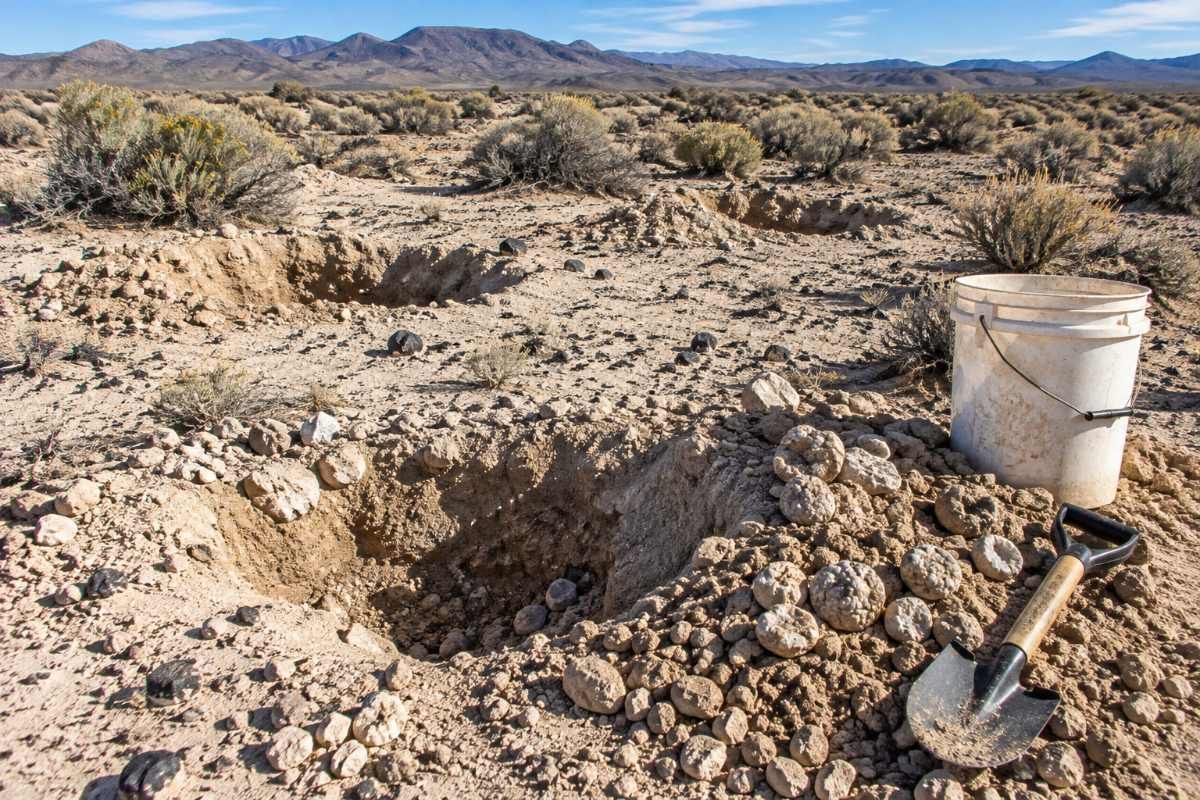
The beds are reached by driving about 50 miles along the Pony Express Trail and Simpson Springs Road, then about 2 miles on an unimproved road. It says the best place to look is in areas that have already been dug. The BLM also warns that tunneling is unsafe and not permitted, because the soft material can collapse at any time. The BLM page lists no special fee, so the general BLM collecting rules below apply. The field office phone number is (435) 743-3100.
Hauser Geode Beds, California
The Hauser Geode Beds are in the Southern California desert, near the BLM’s Wiley’s Well Campground. The campground offers easy four-wheel-drive access to the Hauser Geode Beds, and its season runs September 15 to April 15. Camping there requires a BLM permit, listed at $40 for a short visit and $180 for a long-term stay. The site is managed by the BLM’s Palm Springs South Coast Field Office, (760) 833-7100.
A 2024 field trip notice from the California Federation of Mineralogical Societies says an agreement between the BLM and the federation allows recreational, not commercial, collecting at the beds. It recommends four-wheel drive and warns about heat, dehydration, rattlesnakes, and scorpions.
Oregon Thundereggs
The Ochoco National Forest lists Whistler Springs and White Fir Springs as thunderegg collecting sites. Succor Creek State Natural Area in eastern Oregon allows limited souvenir collecting by rockhounds, up to 1 gallon per person per day and 3 gallons per year. A rough 15-mile dirt road from Oregon 201 leads to the area, and it has no staff on site. Oregon also has private ranches that charge a fee to dig, so check current hours and prices with each one.
Where Store-Bought Geodes Come From
Many geodes sold in shops come from commercial mining. A 2019 New Mexico Mineral Symposium abstract describes geodes from Las Choyas in Chihuahua, Mexico. There, miners hand-dig shafts more than 100 feet deep through volcanic rock to reach the geode layer. The abstract says the geodes come from an area of about two square miles and have become a multimillion-dollar business.
Who Owns the Land? Rules Before You Collect
Finding geodes is only half the job. You also need to know whether you may take them. Our rockhounding for beginners guide covers public land rules in more detail. Here is how they apply to geode hunting.
BLM Land
The BLM’s Can I Keep This? page says you may collect reasonable amounts of rocks for personal use, not for sale or barter, using hand tools that cause only minor surface disturbance. Collecting on a mining claim is prohibited without the claim holder’s permission, and you may not collect in picnic areas or campgrounds. In Oregon and Washington, the BLM collecting guide says you must pay a fee and get a BLM permit, notice, or plan of operations if you take more than 250 pounds, collect for sale, or use power equipment. It also asks collectors to keep holes no deeper than 4 feet.
National Forests
Rules vary by forest, so check with the local ranger district. As one example, the Monongahela National Forest allows rock collecting for personal use only, with non-mechanized hand tools such as a shovel or pick, and says the rocks cannot be sold or bartered.
National Parks
Leave geodes where they are. A federal regulation prohibits disturbing or removing mineral resources in national parks.
State Parks
Most state parks in geode country ban collecting. Besides Iowa’s ban, Missouri State Parks prohibits removing rocks without written permission from the state park director, and Illinois rules make it unlawful to remove natural property from state sites unless a permit or law allows it. Oregon’s Succor Creek is an exception that allows limited souvenir collecting. Check each park’s rules before you go.
Private Land
Much of the best geode ground in the Midwest is private. Ask the landowner first, or choose a fee site or guided hunt where collecting is already allowed.
Geode Hunting Safety
- Plan for desert heat. Western geode beds are remote and hot. A 2016 BLM safety release advises carrying more water than you think you need, telling someone where you are going, and bringing a spare tire.
- Don’t dig under ledges. At Dugway, the soft material can collapse at any time, and tunneling is not allowed.
- Pull fully off the road at road cuts. University field safety rules tell geology students to pull their vehicles completely off the road at roadside stops.
- Stay out of old mines. The BLM warns against entering them.
- Wear eye protection when you break geodes. Chips fly when the shell breaks.
What to Bring
- A rock hammer for checking and breaking stones, such as the Estwing E3-22P rock pick
- Safety glasses, such as the 3M SecureFit 400 with foam gasket
- Work gloves, a small shovel or trowel, and a bucket or sturdy bag
- Plenty of water, sun protection, and a paper map, since remote sites may have no cell service
- The phone number of the land office that manages the site
Our rock hammer guide explains which hammer and glasses to choose. We checked Amazon prices on October 13, 2026.
Gear for this guide2 items


Eye protection
3M SecureFit 400 safety glasses with foam gasket
Wear them whenever you strike rock
Check Price on AmazonWhere to Find Geodes: FAQ
Where can I find geodes near me?
In the Midwest, look around Keokuk, Iowa, in south-central Indiana, and in southern Kentucky. In the West, try the BLM’s Dugway Geode Beds in Utah, the Hauser Geode Beds in California, or Oregon’s thunderegg sites. Check your state geological survey for local geode areas.
Can I take geodes from a state park?
Usually not. Iowa and Missouri state parks prohibit removing rocks without permission, and Illinois rules bar removing natural property from state sites without a permit. Oregon’s Succor Creek State Natural Area is an exception, allowing limited souvenir collecting.
Do I need a permit to collect geodes on BLM land?
Generally not for reasonable amounts for personal use with hand tools. You need permission on mining claims, and in Oregon and Washington the BLM requires a fee and a permit, notice, or plan of operations for more than 250 pounds, commercial collecting, or the use of power equipment.
Can you find geodes in creeks?
Yes. The Iowa, Indiana, and Kentucky geological surveys all say geodes weather out of the rock and collect in streams and creek beds. You still need permission to collect on private land.
What is the difference between a geode and a thunderegg?
A geode is a rock with a hollow center lined with crystals. A thunderegg forms in volcanic ash and is often filled solid with chalcedony, a form of quartz, instead of being hollow. Oregon’s state rock is the thunderegg.
How can you tell if a rock is a geode without breaking it?
Look for a round, lumpy, cauliflower-like surface. A rock that feels light for its size may be hollow, but the Kentucky Geological Survey says there is no secret way to tell from the outside.
Plan Your Geode Hunt
For the most geodes in the smallest area, head to the Keokuk region and book a visit at a site that allows collecting, or join the yearly Geode Fest. For a public-land trip, the BLM’s Dugway Geode Beds in Utah and Hauser Geode Beds in California both allow personal collecting. Thunderegg hunters can try Oregon’s Forest Service sites. Wherever you go, confirm who manages the land, take only what you will use, and bring eye protection for the moment you crack one open.