
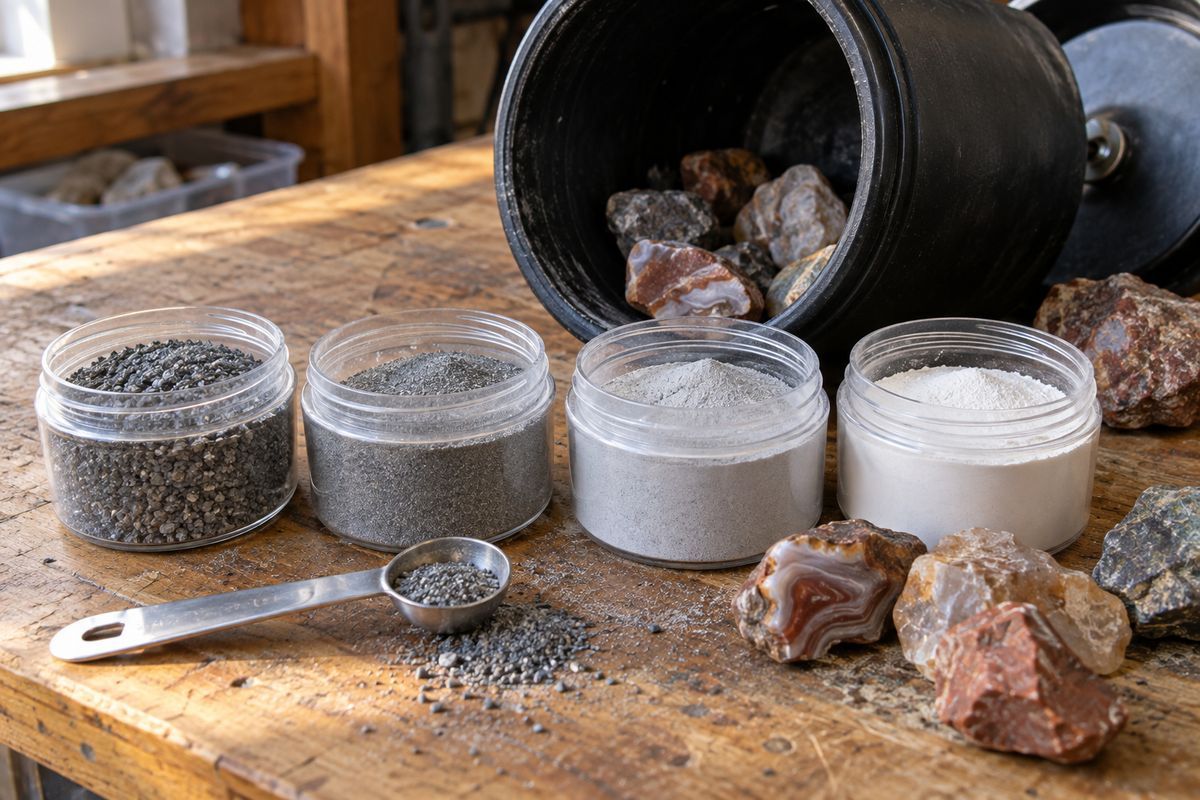
Rock tumbler grit is a hard abrasive powder that grinds rough stones smooth in stages, from coarse to fine, then polishes them for shine. Most rotary tumblers (barrels that turn on rollers) use four steps: coarse 60/90 silicon carbide grit, medium grit around 120/220, fine grit around 500, and a polish such as aluminum oxide or cerium oxide. For most beginners, a labeled four-step kit is the easiest place to start. Once you tumble regularly, buying coarse grit in bulk saves money, because the coarse stage is often run more than once.
Field to Polish is a participant in the Amazon Services LLC Associates Program, an affiliate advertising program designed to provide a means for sites to earn advertising fees by advertising and linking to Amazon.com.
This guide draws on tumbler manufacturers’ instructions, material references, hobby forums, and Amazon listings checked on October 12, 2026. We have not tested these kits ourselves. Where sources disagree on sizes or amounts, we show the range and say who recommends what.
In This Guide
Quick Picks
- Best all-in-one kit: Polly Plastics Grit and Polish Refill with Ceramic Media
- Best value labeled kit: LARICEO 4-Step Grit and Polish Refill, 3 lb
- For National Geographic tumbler owners: National Geographic Grit and Polish Refill Kit
- Best bulk coarse grit: GANGOU 60/90 Silicon Carbide Grit, 5 lb
- Best polish upgrade: TechnologyLK Cerium Oxide Polishing Compound, 1 lb
What Rock Tumbler Grit Is Made Of
Grit has to be harder than the stones it shapes. Quartz is 7 on the Mohs hardness scale, and agate and jasper are close. The abrasives used in tumbling are harder still.
- Silicon carbide is the standard grit for the coarse, medium and fine stages. It is an extremely hard synthetic abrasive, about 9 to 9.5 on the Mohs scale (a 1 to 10 scale of mineral hardness). RockTumbler.com, a tumbling supplier, explains that silicon carbide crushes into sharp, angular pieces and keeps breaking down as it works.
- Aluminum oxide is used for pre-polish and polish. It rates about 8 to 9 on the Mohs scale. Lortone’s tumbler instructions use aluminum oxide for both of the last two steps.
- Cerium oxide is a polishing powder for gemstones and glass. It works on agate, jasper, quartz and glass.
- Tin oxide, sometimes called putty powder, is used to polish glass, marble and jewelry. It is less common in tumbling kits.
The Four Stages and Their Grit Sizes
Every source we checked uses four steps for a rotary tumbler, but they do not all use the same grit sizes. Here is how the main instructions compare:
| Stage | What it does | Common grit | Other sizes you will see |
|---|---|---|---|
| 1. Coarse | Grinds off rough edges and shapes the stone | 60/90 silicon carbide | 80 (Kingsley North) |
| 2. Medium | Removes the scratches left by stage 1 | 120/220 silicon carbide | 150/220 or 180/220 |
| 3. Fine or pre-polish | Smooths the surface for polishing | 500 silicon carbide | 500F, 600, or aluminum oxide pre-polish (Lortone) |
| 4. Polish | Brings out the shine | Aluminum oxide | Cerium oxide or tin oxide |
Sources: Lortone’s 3A instructions and QT instructions, plus the published instructions from RockTumbler.com and Kingsley North, two tumbling suppliers. The small differences between medium and fine sizes matter less than following one sequence through and cleaning well between stages.
Each stage usually runs about a week in a rotary tumbler. RockTumbler.com’s instructions use about 7 days per step, and Lortone’s QT instructions say to check the stones after 2 to 3 days and rinse them after 5 to 7 days. Hard, rough material often needs the coarse stage repeated with fresh grit before the stones are ready for stage 2. Our guide on how to tumble rocks walks through each stage step by step.
What the Grit Numbers Mean
A grit number describes particle size. The higher the number, the finer the grit. A label like 60/90 means the bag holds a blend of particles between those two sizes, not a single size.
Here are approximate average particle sizes on the US grading scale, from a widely shared grit size chart. The chart is for sandpaper grades, so loose tumbling grit can vary a little:
| Grit | Approximate particle size | Used for |
|---|---|---|
| 60 | About 270 microns | Coarse stage |
| 120 | About 116 microns | Medium stage |
| 220 | About 66 microns | Medium stage |
| 500 | About 20 microns | Fine stage |
| 600 | About 16 microns | Fine stage |
| 1000 | About 9 microns | Extra fine pre-polish |
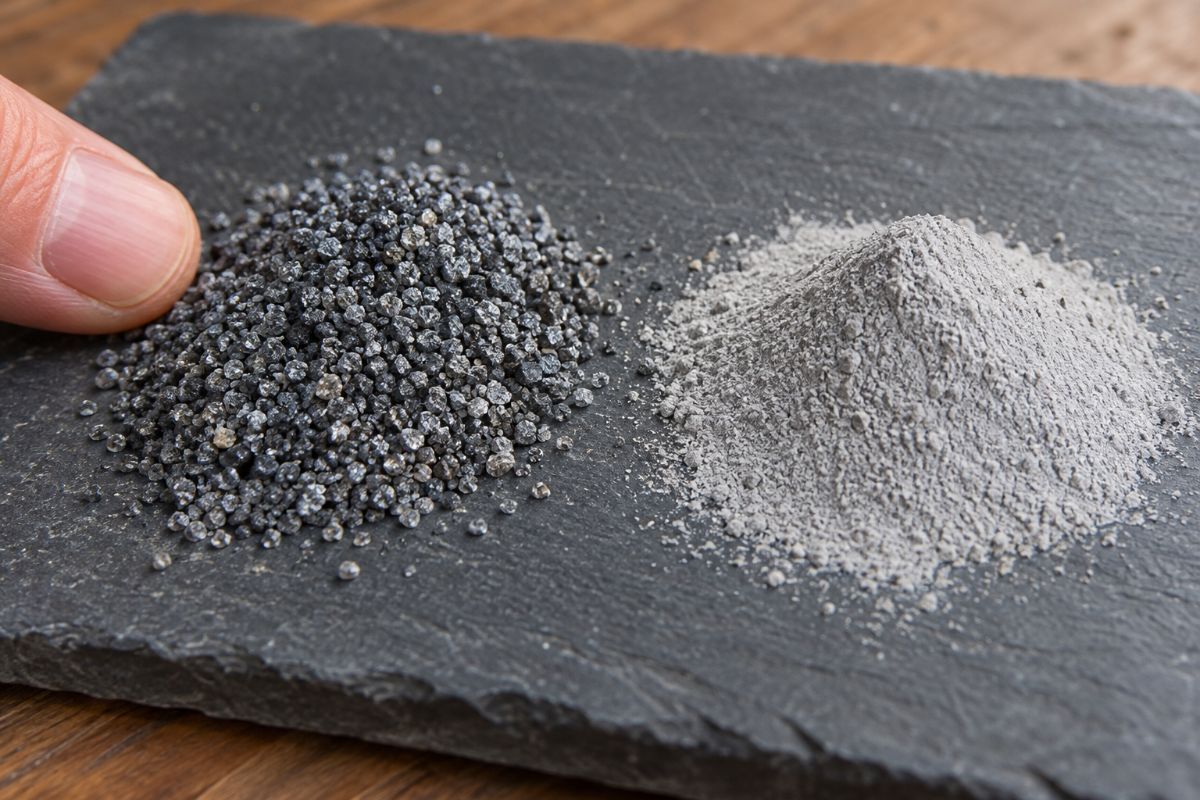
A micron is one thousandth of a millimeter. For finer grits, other grading standards give different sizes. European P grades, for example, run larger. Polish labels are even less consistent. Labels such as 1200- or 8000-grit polish aren’t on a shared scale, so you cannot compare them by number alone. RockTumbler.com, for example, describes its polishes by micron size rather than grit number.
How Much Grit to Use
Use the amount your tumbler’s maker recommends. The common guides do not agree exactly, so here is what each one says:
| Source | Barrel or load | Coarse | Medium | Fine or pre-polish | Polish |
|---|---|---|---|---|---|
| Lortone 3A | 3 lb barrel | 4 Tbsp | 4 Tbsp | 6 Tbsp | 6 Tbsp |
| Lortone QT6 | 6 lb barrel | 10 Tbsp | 10 Tbsp | 12 Tbsp | 12 Tbsp |
| Lortone QT12 | 12 lb barrel | 20 Tbsp | 20 Tbsp | 24 Tbsp | 24 Tbsp |
| RockTumbler.com | Per pound of rock | 2 Tbsp | 2 Tbsp | 2 Tbsp | 2 Tbsp |
| Kingsley North | 3 cup barrel | 4 Tbsp | 4 Tbsp | 6 Tbsp | 3 Tbsp |
Lortone and RockTumbler.com give these as level tablespoons. Lortone’s QT instructions also say to fill the barrel about 1/2 to 2/3 full of rock, then add water to cover the rocks and grit without overfilling. A barrel under half full lets stones crash and chip, and an overfilled barrel doesn’t tumble well. For vibratory tumblers (bowls that shake instead of turning), use about half as much grit as a similarly sized rotary tumbler.
Our rock tumbler calculator uses these charts to work out the grit, weeks and cost for your tumbler.

How We Chose These Kits
We looked for grit kits and refills that are sold on Amazon with a buy button and a meaningful number of ratings, and we favored listings that state the grit size and weight for each stage. We also read owner threads on the Rock Tumbling Hobby forum and added repeated problems as cons. Prices change often, so we did not use them to rank the picks.
The 5 Best Rock Tumbler Grit Kits and Refills
Pick 01Best all-in-one kit
Polly Plastics Grit and Polish Refill

The Polly Plastics kit gives you all four stages plus ceramic filler media in one box. The listing spells out the contents: 1 lb of 60/90 coarse silicon carbide, 1 lb of 180/220 medium silicon carbide, 1/2 lb of 500 fine silicon carbide, and 1/2 lb of aluminum oxide polish labeled 1200. Ceramic media (small ceramic pellets that cushion the stones) cushions stones and fills the barrel when you don’t have enough small rock.
Good for: beginners who want everything for several batches in one order.
- Pros: every stage labeled by grit size and weight, ceramic media included, works in any rotary tumbler.
- Cons: the 1200 polish label isn’t a standard measure, and large tumblers use the coarse grit quickly.
Pick 02Best value labeled kit
LARICEO 4-Step Refill

The LARICEO 3 lb refill set uses the same four sizes as the Polly kit: 60/90 and 180/220 silicon carbide at 1 lb each, smaller amounts of 500 silicon carbide, and a 1200 aluminum oxide polish. It includes a measuring spoon and instructions, but no ceramic media.
Good for: anyone who already has filler media and just needs a labeled refill.
- Pros: clear grit sizes for every stage, spoon and instructions included, lower cost than kits with media.
- Cons: fewer ratings than the bigger brands, and the listing describes the fine and polish amounts confusingly, so check the jar labels when it arrives.
Pick 03For National Geographic tumbler owners
National Geographic Refill Kit

The National Geographic Grit and Polish Refill Kit is the most popular grit kit we found. The listing says it holds over 3 pounds of grit across four stages in screw-top jars, comes with a 10 mL scoop and treats up to 20 pounds of rock. If you own a National Geographic tumbler, it matches the steps in that kit’s instructions.
The listing does not state the grit size for each stage. Owners on the Rock Tumbling Hobby forum have also reported dull results with the National Geographic polish step, for example in this thread and this one. One forum member said the kit’s fourth step is closer to a pre-polish than a true polish. If your stones come out matte, the usual next step is a separate aluminum oxide or cerium oxide polish.
Good for: owners of National Geographic tumblers who want to follow the kit instructions exactly.
- Pros: very widely used, easy to measure, sturdy jars.
- Cons: grit sizes are not listed, and some owners report a weak final polish.
Pick 04Best bulk coarse grit
GANGOU 60/90 Silicon Carbide, 5 lb

The coarse stage often has to be repeated, so regular tumblers can run out of coarse grit first. The GANGOU 5 lb bag is graded 60/90 silicon carbide in a resealable bag, according to the listing.
Good for: anyone who tumbles often and wants to stop buying full kits just to get more coarse grit.
- Pros: large amount of the stage you often repeat, resealable bag, works in any tumbler.
- Cons: coarse grit only, so you still need medium, fine and polish from another source.
Pick 05Best polish upgrade
TechnologyLK Cerium Oxide

If your quartz-family stones or glass come out of the polish stage looking dull, switching the final step to cerium oxide is one fix many hobbyists try. The TechnologyLK 1 lb cerium oxide is sold as a high-grade polishing compound and scratch remover for glass, according to the listing. That is the same job it does on quartz-family stones in a tumbler.
Good for: agate, jasper, quartz, obsidian, and tumbled glass.
- Pros: a full pound of polish, a good fit for quartz-family stones and glass.
- Cons: polish only, so you still need grit for the first three stages.
Comparison Table
| Product | What you get | Grit sizes listed | Best for | Amazon rating |
|---|---|---|---|---|
| Polly Plastics | 4 stages plus ceramic media | 60/90, 180/220, 500, 1200 polish | Beginners | 4.7 (7,379) |
| LARICEO 3 lb | 4 stages, spoon, instructions | 60/90, 180/220, 500, 1200 polish | Labeled refill on a budget | 4.7 (330) |
| National Geographic refill | 4 stages, over 3 lb, scoop | Not listed | National Geographic tumblers | 4.7 (14,515) |
| GANGOU 5 lb | Coarse grit only | 60/90 | Frequent tumblers | 4.8 (490) |
| TechnologyLK | Cerium oxide polish only | Not applicable | Quartz, agate, glass | 4.4 (272) |
Amazon ratings and counts were checked on October 12, 2026, and they change over time.
Grit for Rotary vs Vibratory Tumblers
Rotary tumblers shape stones, so they use all four stages. Vibratory tumblers mostly smooth the surface and do not change a stone’s shape much. Because of that, RockTumbler.com starts vibratory batches with a medium grit, such as 150/220, using rocks already shaped in a rotary tumbler. It also uses about half as much grit as in a rotary tumbler. If you are still choosing a machine, our rock tumbler buying guide compares the two types.
Which Polish Works Best for Which Stone
Aluminum oxide is the most popular tumbling polish, and it works on most agate, jasper and quartz. RockTumbler.com, a tumbling supplier, offers this general guide:
- Aluminum oxide: almost any agate, jasper or quartz.
- Cerium oxide: agate, jasper, quartz, petrified wood, obsidian, and glass. Many people also prefer it for feldspar stones such as moonstone, labradorite, sunstone, and amazonite.
- Tin oxide: quartz, jasper, agate, and obsidian. Many people also use it for soft stones such as calcite, rhodochrosite, and malachite.
We could not find an independent source that ranks these polishes by stone, so treat this as a supplier’s experience rather than a rule.
Can You Reuse Rock Tumbler Grit?
Not really. Silicon carbide breaks down as it works, so used grit is mostly fine powder mixed with rock dust. Recycling grit is mostly a waste of time. When you repeat the coarse stage, use a fresh grit charge because the old grit has broken down too much to keep shaping the stones. Keep the polish clean and free of leftover grit.
Keeping Grit Out of the Polish
A few grains of coarse grit left in the barrel can scratch stones during the later stages. Lortone’s instructions tell owners to clean the rocks and barrel parts thoroughly with mild soap and water between steps. Some people keep a separate barrel just for the polish stage.
Hobbyists do not all agree on how serious this is. In a Rock Tumbling Hobby forum thread, some members called the risk overstated, while others said it matters most for pitted or cracked stones and for the polish stage, where grit can hide in holes and come out later. Rinsing pitted stones well, or scrubbing them with a brush, helps clear trapped grit.
Grit Safety and Disposal
- Never pour slurry (the gritty mud that forms in the barrel) down a drain. Lortone’s instructions warn that rinse water with grit in it will clog household drains. Our tumbling guide covers how to settle and dispose of it.
- Keep dust down. The National Institute for Occupational Safety and Health (NIOSH) Pocket Guide lists exposure limits for silicon carbide dust at work. The rock you grind can also release crystalline silica, which the Occupational Safety and Health Administration (OSHA) says can cause silicosis (a lung disease caused by breathing in rock dust) when breathed in as fine dust. Pour dry grit gently, keep slurry wet, and do not sweep up dried slurry dust.
- Protect your hands and eyes. Wear gloves when handling slurry, and rinse grit off your skin. Keep grit away from your eyes.
- Store grit dry and labeled. Use sealed containers labeled with the grit size so stages don’t get mixed up.
Frequently Asked Questions
What grit do I need for a rock tumbler?
Most rotary tumblers use four steps: 60/90 silicon carbide for coarse grinding, about 120/220 for medium, about 500 for fine, and a polish such as aluminum oxide or cerium oxide. A labeled four-step kit covers all of them.
How much grit do I use per pound of rock?
It depends on the tumbler. RockTumbler.com uses about 2 level tablespoons per pound of rock in a rotary tumbler. Lortone’s 3 lb barrel instructions call for 4 tablespoons of coarse grit. Follow your tumbler’s manual first.
What does 60/90 grit mean?
It is a blend of particles between 60 and 90 grit. Higher grit numbers are finer. 60 grit particles average roughly 270 microns across.
Can you reuse rock tumbler grit?
Not in a useful way. Silicon carbide breaks down as it works, so suppliers recommend a fresh grit charge for each stage and each repeat of the coarse stage.
Why are my stones still dull after the polish stage?
Common causes include scratches not removed in the fine stage, grit left over from an earlier stage, and soft stones that will not take a high polish. A cloudy film from hard water or polish can also dull stones. Run the fine stage again, clean everything well, and try a fresh polish such as cerium oxide.
Is rock tumbler grit dangerous?
Dust is the main concern. NIOSH lists workplace exposure limits for silicon carbide dust, and rock dust can contain crystalline silica. Keep slurry wet, wear gloves, and never pour slurry down a drain.
Which Rock Tumbler Grit to Buy
For most beginners, the Polly Plastics kit is the easiest choice, because it labels every stage and includes ceramic media. The LARICEO set is a good labeled refill if you already have media. If you own a National Geographic tumbler, its refill matches your instructions, but keep a better polish on hand. Once you tumble regularly, buy coarse 60/90 grit in bulk, since you often repeat that stage, and consider cerium oxide for quartz, agate, and glass.
New to the hobby? Start with rockhounding for beginners, then see how to tumble rocks.