
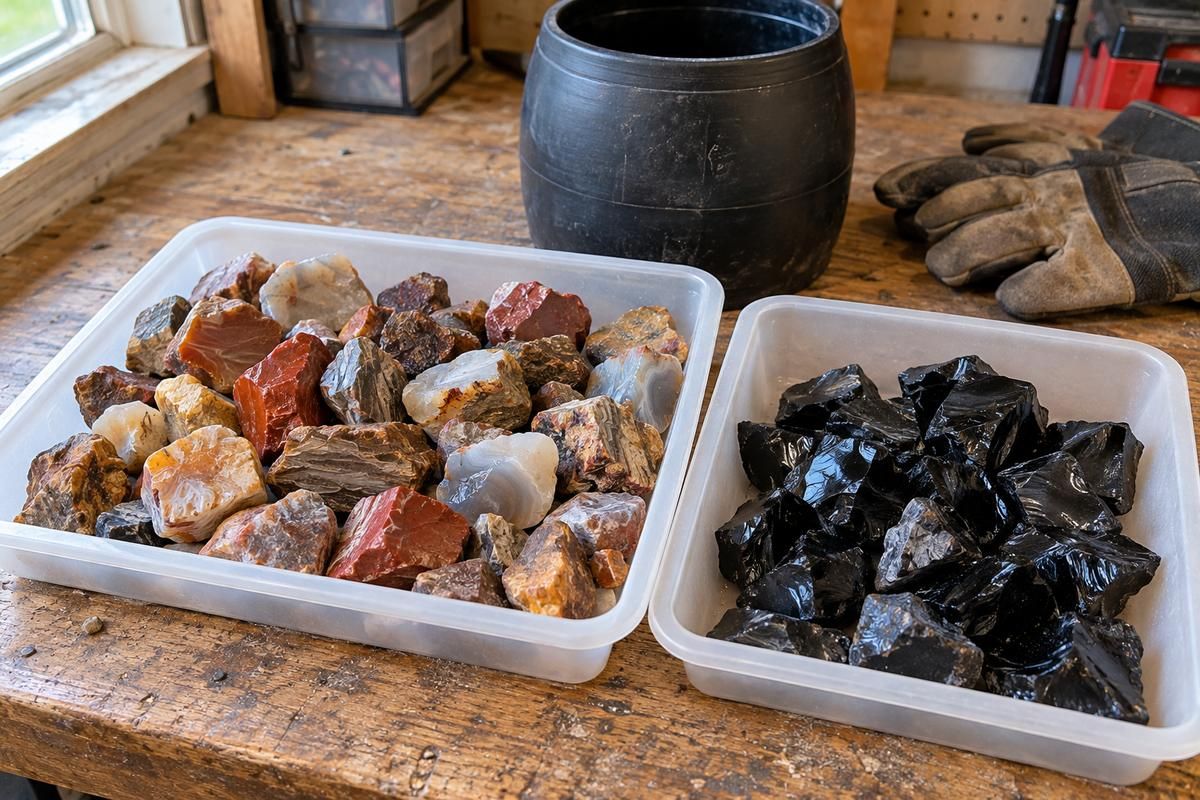
The best rocks for tumbling are agate, jasper, and solid petrified wood. All three are made of quartz, rate about 7 on the Mohs hardness scale, and are tough enough to survive weeks of rolling in a rotary tumbler. Clear quartz, rose quartz, amethyst, tiger’s eye, and feldspar can also turn out well, as long as the piece you choose has no cracks. Obsidian and sodalite are softer, so they need a batch of their own. A few kinds of rock should never go in the barrel at all: very soft rock, crumbly rock, rock full of tiny holes, and rock that dissolves in water.
We have not tested these stones ourselves. Instead, this guide brings together mineral data from the U.S. Geological Survey (USGS) and Mindat, a large online mineral database, along with collecting rules from land agencies and advice from tumbling suppliers and experienced hobbyists. Think of it as a well-sourced starting point.
In This Guide
Best Rocks for Tumbling at a Glance
| Rock | Mohs hardness | Verdict | Why |
|---|---|---|---|
| Agate | 6.5 to 7 | Best choice | Quartz made of tiny crystals, with few weak spots |
| Jasper | 6.5 to 7 | Best choice | Quartz made of tiny crystals, solid in color |
| Petrified wood | About 7 | Best choice if solid | Wood replaced by almost solid quartz |
| Clear, rose, or purple quartz | 7 | Good if crack-free | Hard, but crystals often hide cracks |
| Tiger’s eye | About 7 | Good, with a dust note | Quartz with tiny mineral fibers sealed inside |
| Feldspar | 6 to 6.5 | Workable | A little softer than quartz |
| Sodalite | 5.5 to 6 | Tumble alone | Softer, so it wears down next to quartz |
| Obsidian | 5 to 5.5 | Tumble alone, with care | Soft volcanic glass with razor-sharp edges |
| Turquoise | 5 to 6 | Avoid | Soft and often full of tiny holes |
| Malachite | 3.5 to 4 | Only with other soft stones | Far softer than quartz |
| Fluorite | 4 | Avoid | Soft and splits easily |
| Pyrite | 6 to 6.5 | Avoid | Can break down and release acid when damp |
| Calcite | 3 | Avoid | Too soft |
| Gypsum, including selenite | 2 | Avoid | Too soft |
A note on the numbers: hardness values come from the USGS gemstone guide and Mindat, which lists agate and jasper as types of chalcedony, a form of quartz. Tiger’s eye and petrified wood are mostly quartz, so we place them near quartz’s 7. Each source is linked in the sections below.
Why Some Rocks Tumble Better Than Others
A rotary tumbler works like a slow, wet grinder. It turns a sealed barrel of stones, water, and grit, a gritty powder that wears the stones smooth, and it keeps turning for days at a time. That is a rough life for a rock, and the ones that come out looking good tend to share a few traits.
Hardness matters most. It describes how well a stone resists scratches, and geologists rate it on the Mohs scale, which runs from 1 for talc to 10 for diamond. Quartz is a 7 on that scale. Stones close to that number wear down slowly and take a good shine.
A stone also needs to be solid all the way through. Cracks, holes, and soft patches catch grit and tend to break open as the barrel turns. Texture plays a part too. Rocks made of tiny, tightly packed crystals polish more evenly than rocks with large crystals or loose grains.
Agate and jasper have all of these qualities. Mindat describes chalcedony as quartz made of crystals too small to see, and it lists both agate and jasper as forms of chalcedony with a hardness of 6.5 to 7. So it makes sense that they turn up in so many tumbler barrels.
Match the Stones in Each Batch
A batch is one load of stones that you tumble together. Mixing hard and soft stones in the same load causes trouble, because harder stones and grit grind softer stones away much faster. A soft stone in a quartz batch can come out much smaller than it went in, or worn down to tiny bits. RockTumbler.com, a tumbling supplier, advises tumbling stones of similar hardness together. If your collection is a mix, split it into a quartz batch and a separate soft batch.
When you can’t tell how hard a stone is, a quick scratch test helps. Our guide on how to polish rocks shows how to do one with a knife blade and a piece of glass.
Three Easy Choices for Beginners
Agate
Agate is a type of chalcedony with bands of color, often in rings or stripes. It is translucent, so light shines through it, and a good piece can polish to a glassy shine. RockTumbler.com counts it among the most commonly tumbled materials. Our types of agate guide shows the main patterns and how to tell agate from jasper.
Many people find agate for themselves. In the upper Midwest, the Minnesota Department of Natural Resources (DNR) says Lake Superior agates are made of chalcedony quartz and turn up on Lake Superior beaches and in gravel along rivers and streams. If you go looking for them, watch for a waxy shine, rust-red or yellow staining, and a stone that glows when you hold it up to the sun.
Jasper
Jasper is a close relative of agate. Both are chalcedony, but light cannot pass through jasper, and it comes in red, yellow, brown, and green. Because the two are about equally hard, they can share a barrel without one wearing the other away.
Petrified Wood
Petrified wood is wood that turned to stone. The National Park Service says the petrified wood at Petrified Forest National Park is made of almost solid quartz. It formed when silica, the material quartz is made of, soaked into the wood from volcanic ash as the wood decayed. Solid pieces tumble much like jasper and often keep the grain of the original tree. Pieces that are flaky, cracked, or still feel like wood are better left out.
Collecting your own comes with limits. On its land, the Bureau of Land Management (BLM) lets you take up to 25 pounds plus one piece of petrified wood per day. The yearly cap is 250 pounds per person, unless a local rule says otherwise. National parks are off limits. Collecting rocks there is generally prohibited under 36 CFR 2.1.
Stones That Need a Little More Care
Can You Tumble Quartz?
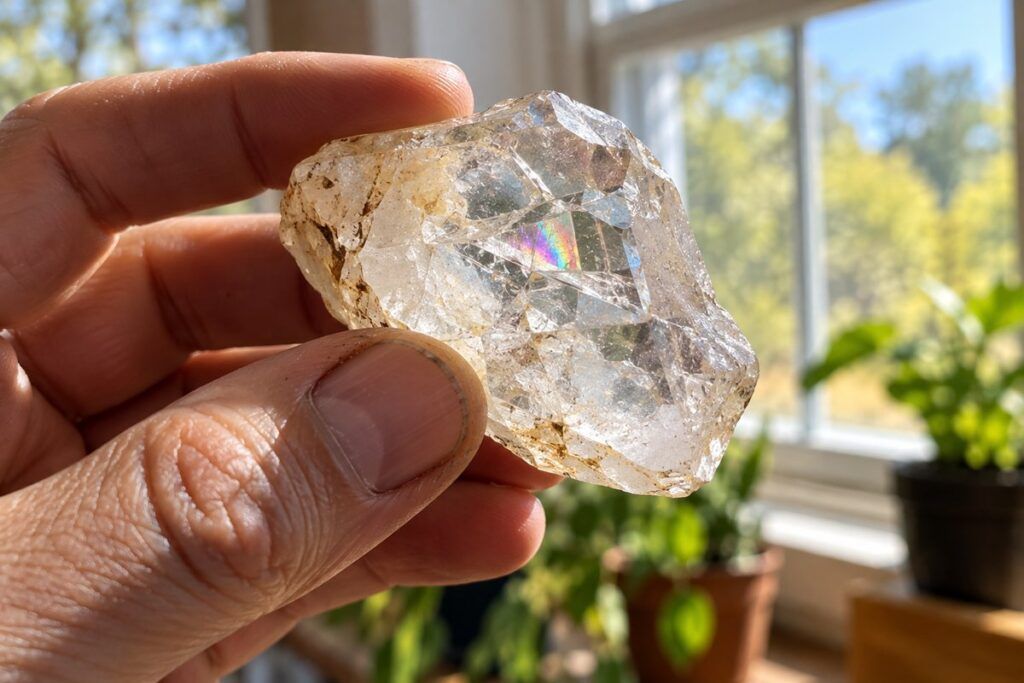
Yes, as long as you choose your pieces carefully. Quartz is a 7 on the Mohs scale, so hardness is not the problem. Hidden cracks are, and quartz crystals such as clear quartz, rose quartz, and amethyst often have them. One member of the Rock Tumbling Hobby forum described this in a 2015 thread. Their beach quartz looked fine after the first two grinding stages, then came out scratched and cracked at the pre-polish stage, the last step before the final polish. Other members blamed cracks inside the stone and said agate, jasper, and petrified wood are easier for beginners.
Checking only takes a moment. Hold each piece up to a bright light and turn it slowly. Thin, shiny lines or rainbow flashes inside a stone often mean cracks. Set those pieces aside.
Tiger’s Eye
Tiger’s eye is quartz with tiny mineral fibers that create a shimmering band of light. A Scientific American article explains research by Peter Heaney and Donald Fisher. They found that the stone is made of tiny quartz columns that hold even tinier fibers of a mineral called crocidolite. Because it is quartz, it can go in a quartz batch.
There is one catch. Crocidolite is an asbestos mineral listed by OSHA. In tiger’s eye, the fibers are sealed inside the quartz, and we could not find official guidance on whether tumbling it releases any. Playing it safe is easy. Keep the slurry, the gritty mud in the barrel, wet. Clean up spills before they dry, and never sand or grind tiger’s eye dry.
Feldspar and Sodalite
Feldspar sits just below quartz on the hardness scale, at 6 to 6.5. Sodalite, a deep blue stone, is softer still at 5.5 to 6. Both can be tumbled, but both wear faster than quartz. Sodalite in particular does better in its own batch than mixed with agate and jasper.
Tumbling Obsidian Safely
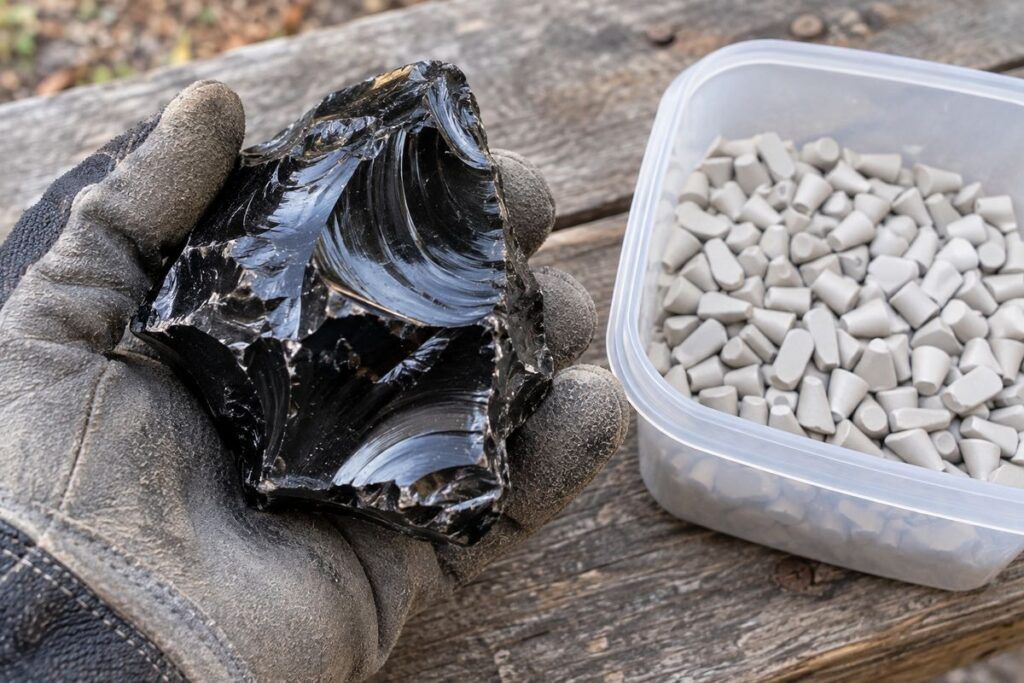
Obsidian can be tumbled, but it is not a beginner stone. It is volcanic glass. Oregon State University’s volcano site says it rates only 5 to 5.5 on the Mohs scale, compared with 7 for quartz, and that its broken edges can be sharper than a razor. Both facts shape how you handle it.
Because obsidian wears much faster than quartz, it needs a barrel of its own. Never mix it with agate or jasper. It also needs cushioning. RockTumbler.com suggests making about half the load ceramic media, which are small ceramic pellets that soften the impacts, and skipping the first, roughest grit stage. Protect your hands, too. Rough obsidian can cut skin, so wear gloves when you sort and load sharp pieces.
In the US, obsidian is found only in parts of the West. In Oregon, the BLM lists the Glass Buttes obsidian area as a place set aside for rock collecting, and its guide says you don’t need a permit for a reasonable amount for personal use.
What to Leave Out of the Barrel
Some rocks waste grit, ruin a batch, or make a mess. The softest ones are the easiest to rule out. Calcite rates 3 and gypsum rates 2, and selenite is a clear form of gypsum. In a barrel with quartz, these grind down to almost nothing.
Fluorite is a little harder, at 4, but it has a different weakness. It splits very easily along flat surfaces, so it tends to chip and split in a rolling barrel.
Stones full of tiny holes cause another kind of trouble. The Gemological Institute of America (GIA) rates turquoise at 5 to 6 and says turquoise with more tiny holes takes a duller polish. Those holes also trap grit and carry it into the next stage. Crumbly or layered rock, such as many sandstones and shales, fails in a simpler way. It breaks into grains or flakes and falls apart instead of rounding.
Water is the problem for a few minerals. Pyrite rates 6 to 6.5, which sounds hard enough, but it slowly breaks down when damp and releases sulfuric acid. Weeks of wet tumbling is the opposite of what it needs. Rock salt, also called halite, simply dissolves.
The most serious case is rock made of fibers. OSHA lists six asbestos minerals: chrysotile, amosite, crocidolite, tremolite, anthophyllite, and actinolite. It says the fibers can cause lung disease when breathed in. Do not grind or tumble any rock that looks like it has loose fibers. Tiger’s eye, covered above, is different because its fibers are sealed inside quartz.
Malachite is a gray area. It rates only 3.5 to 4, so it cannot go in a quartz batch. On the Rock Tumbling Hobby forum, some members tumble it alone or with other soft stones, with plenty of ceramic media to cushion them. Mindat has no health data for malachite, but avoid breathing dust from any rock you grind.
Choosing Rough Before It Goes In
Rough is rock that has not been shaped or polished yet. Whether you buy it or collect it, a few minutes of sorting before you load the barrel can save a whole batch.
Size is the easy part. Stones about 3/8 inch to 1 1/2 inches across, in a mix of sizes, are a good range. Our guide on how to tumble rocks covers rough size in more detail.
Next, look closely at each piece. You want a solid stone made of tiny crystals, with no visible cracks, holes, or crumbly spots. Hold see-through stones up to a light to check for cracks inside. If a piece has a soft crust or chunks of other rock stuck to it, knock them off or skip the piece. When you are not sure of a stone’s hardness, do a scratch test and sort it with stones of similar hardness.
Good rough matters as much as good technique. The right grit and timing cannot fix a stone that is cracked or too soft. For the grit side, see our guide to rock tumbler grit.
Where You Can Collect Legally
Many good tumbling rocks come from gravel. The Minnesota DNR says agates are found on public Lake Superior beaches, in gravel pits, and along rivers and streams. It also says rock collecting is not allowed in Minnesota state parks, state recreation areas, or scientific and natural areas, and that gravel pits are often private, so you need the owner’s permission.
Elsewhere, the rules usually follow a similar pattern. On BLM land, you can collect reasonable amounts for personal use with hand tools, with special limits for petrified wood. National parks do not allow collecting. State park rules vary by state, and many ban it. On private land, always ask the owner first.
Our guide to rockhounding for beginners covers land rules and field gear in more detail. If you want a specific target, our guide on where to find geodes lists US sites and the rules at each.
Dust, Slurry, and Staying Safe
Agate, jasper, and quartz are forms of silica, and grinding them makes fine silica dust. The National Institute for Occupational Safety and Health (NIOSH) says breathing too much fine quartz dust, called crystalline silica, can cause silicosis, a lung disease that cannot be reversed but can be prevented.
Tumbling is wet, which keeps dust down. The risk comes from dried slurry, the gritty mud left in the barrel and buckets. Wipe up spills while they are still wet, because dry sweeping can put silica dust in the air.
Slurry also needs care when you clean up. The Lortone tumbler instructions warn that rinse water can clog household drains, so rinse stones in a bucket rather than a sink or toilet. Kingsley North, a tumbling supplier, says to throw used slurry in the trash. Many tumblers let it settle first and pour off the clear water outside.
Best Rocks for Tumbling: Common Questions
What are the best rocks for tumbling for beginners?
Agate, jasper, and solid petrified wood. They are all forms of quartz, rate about 7 on the Mohs scale, and polish well in the same batch.
What rocks can you tumble together?
Rocks of similar hardness. Agate, jasper, petrified wood, tiger’s eye, and solid quartz can share a barrel. Softer stones such as obsidian and sodalite need their own batch.
Can you tumble quartz?
Yes. Quartz is hard enough, but crystal quartz often has hidden cracks that break open in the tumbler. Hold each piece up to a light and skip any with visible cracks.
Can you tumble obsidian?
Yes, but tumble it alone, cushion it with ceramic media, and wear gloves. It rates only 5 to 5.5 on the Mohs scale, and its edges can be sharper than a razor.
What rocks should you not tumble?
Skip very soft minerals like calcite and gypsum, fluorite, rock that crumbles or is full of tiny holes, pyrite, minerals that dissolve in water, and any rock made of fibers that might contain asbestos.
Can you tumble rocks from your yard or driveway?
Sometimes. Hard, solid stones made of tiny crystals can work, but many yard and driveway rocks are soft, crumbly, or full of cracks. Do a scratch test and check for cracks before you add them to a batch.
Putting Together Your First Batch
For a first batch, keep it simple: agate, jasper, and solid petrified wood of similar size. Once you know what a good batch looks like, you can try quartz crystals, tiger’s eye, and feldspar. Obsidian and other soft stones get a barrel of their own. If you still need a tumbler, our rock tumbler buying guide can help.