
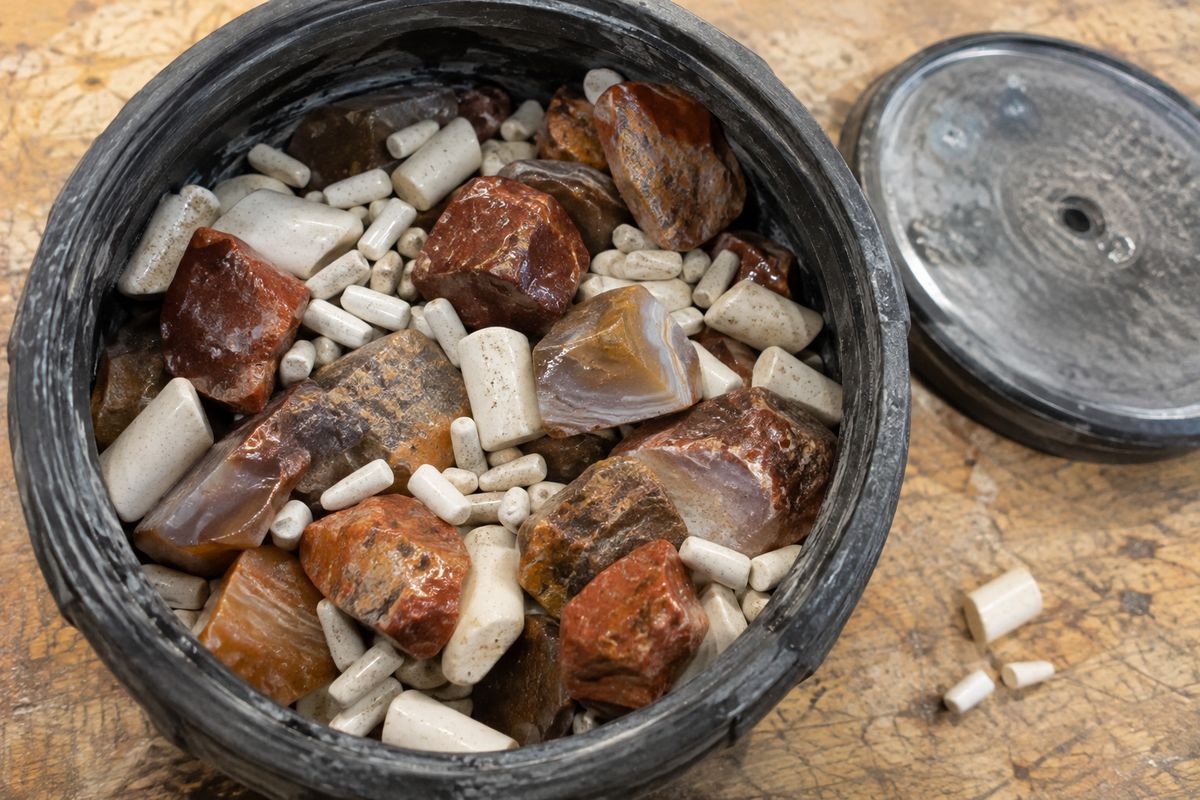
Rock tumbler media is a filler you add to the barrel with your rocks, usually small ceramic cylinders or plastic pellets. It cushions the stones so they chip and bruise less, fills the space lost as rocks grind down, and helps carry grit to every surface. Most beginners do best with a bag of mixed-size, non-abrasive ceramic media, used at up to about 10 percent of the load for hard stones like agate and much more for fragile ones.
Field to Polish is a participant in the Amazon Services LLC Associates Program, an affiliate advertising program designed to provide a means for sites to earn advertising fees by advertising and linking to Amazon.com.
This guide is research-based. We have not used these products ourselves. Amounts and steps come from RockTumbler.com’s tumbling guides and the makers’ product pages, and product details come from the Amazon listings.
In This Guide
Quick Picks
- Best first bag: Polly Plastics Ceramic Filler Media, Small and Large Mixed, 3 lb
- Best for fragile stones and the polish step: Polly Plastics Ceramic Filler Media, Small Cylinder, 3 lb
- Best filler for big rocks: Polly Plastics Ceramic Filler Media, Large Cylinder, 1.5 lb
- Best bulk bag for large barrels: YHAspace Ceramic Filler Media, Small Cylinder, 8 lb
- Plastic pellets for rotary tumblers: Polly Plastics Polypropylene Plastic Pellets, 1 lb
What Rock Tumbler Media Does
Media is not grit. Grit is the abrasive powder that grinds and polishes the stones. Media is the filler that rides along with it. RockTumbler.com’s guide to tumbling media, written by geologist Hobart King, lists five jobs it does.
- Cushioning. Media sits between the stones, so they hit each other less often and with less force. That means fewer chips and bruises.
- Filler. Coarse grit can grind away 10 to 30 percent of a load’s volume, according to RockTumbler.com. Media brings the barrel back to the right level.
- Size balance. A load of only large stones has big gaps. Small media fills them, so more surfaces touch and grind.
- Better tumbling action. Flat slabs and angular pieces tend to slide instead of roll. Media acts a bit like roller bearings and gets them turning.
- Grit delivery. Media carries grit into dips and corners that larger stones cannot reach.
Makers also say ceramic media quiets the tumbler. Polly Plastics’ listings describe its ceramic media as something that “cushions, quiets and improves tumbling action.”
Ceramic Media vs Plastic Pellets
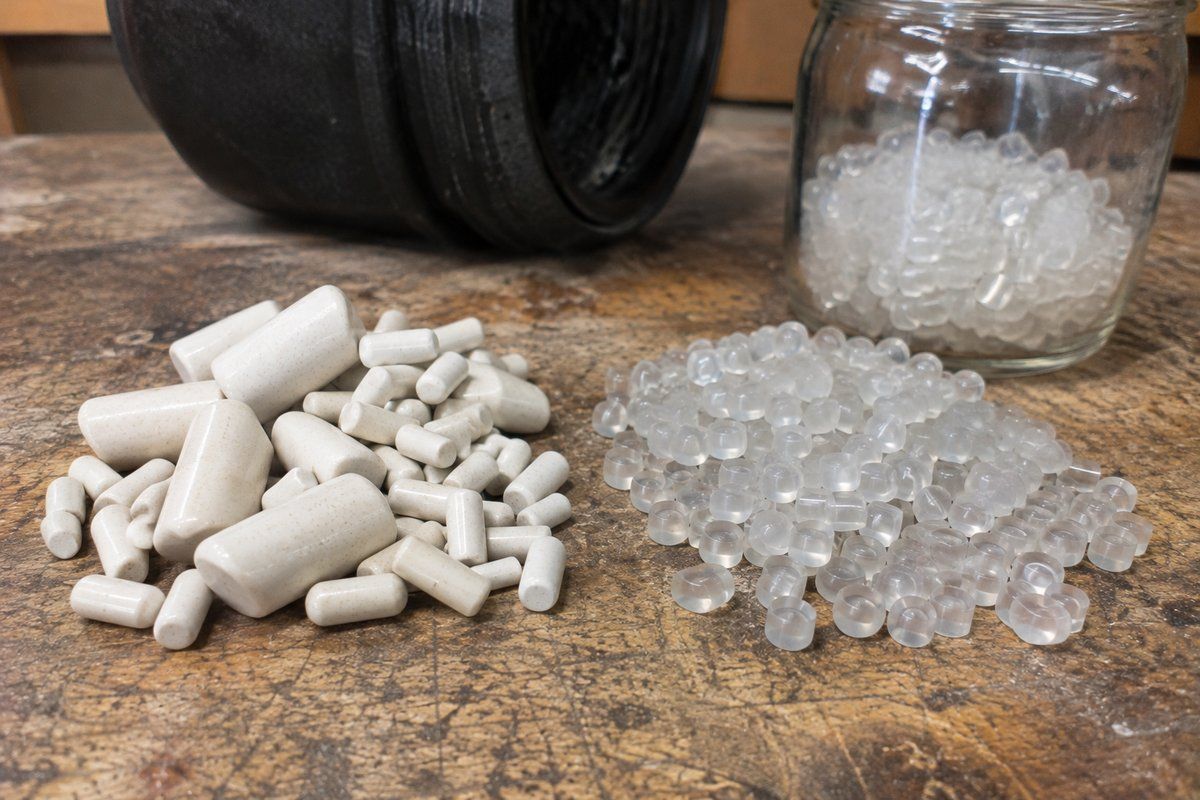
The two common types are fired ceramic cylinders and plastic pellets. Ceramic has become the usual choice. RockTumbler.com says it sells more than 10 times as much ceramic as plastic.
| Ceramic media | Plastic pellets | |
|---|---|---|
| What it is | Kiln-fired ceramic cylinders, hardness of 7 or more on the Mohs scale | Small, soft plastic beads |
| Main job | Filler and cushioning, and it helps the grinding | Cushioning only. Too soft to help grind. |
| Rotary tumblers | Yes | Yes |
| Vibratory tumblers | Yes | Not recommended by RockTumbler.com |
| Between steps | Rinse it and move it to the next step | Grit gets stuck in the plastic. Keep a separate set for each step. |
| Lifespan | Large pieces last many batches and wear into small ones. Small pieces last a few cycles. | Reusable, but only within the same step |
Plastic pellets still have a place. They float, so they are easy to scoop off, and some hobby guides like them for cushioning delicate stones in the later steps. If you use them, label a container for each grit step and never let coarse-grit pellets into the polish.
Always buy ceramic sold as non-abrasive. RockTumbler.com warns that some ceramic media has abrasive particles baked in, and that kind will scratch your stones in the polish step.
How Much Media to Use
The right amount depends on how tough your stones are. These amounts come from RockTumbler.com’s media guide and are volume shares of the load.
| Your stones | Examples | Media in the coarse step |
|---|---|---|
| Durable | Agate, jasper, chalcedony | None, or up to about 10 percent |
| Less durable | Stones that cleave easily, such as fluorite, moonstone and labradorite | 10 to 50 percent, every run |
| Fragile | Obsidian, glass, crystal quartz | At least 50 percent |
For a general rotary load in coarse grit, RockTumbler.com suggests about 10 percent media. It allows up to about 20 percent when the barrel is full of large rocks with nothing small between them.
Then use media to keep the barrel at the right level. RockTumbler.com recommends filling a rotary barrel about two-thirds full. Lortone’s instructions for its tumblers say about half to two-thirds full, as our how to tumble rocks guide explains. If your rocks only reach halfway, add media to make up the difference. After each step, your rocks will be smaller, so top up again.
Not sure how many rocks you need? Our rock tumbler calculator works out grit and cost for a batch.
Rock Tumbler Media Planner
Choose your tumbler, your stones, the step you are on, and how full the barrel is with rock. The planner suggests which media to use and roughly how much.
Rock Tumbler Media Planner
Pick your setup to see which media to use and about how much.
Media planner by Field to Polish. Based on RockTumbler.com guidance. Pounds are a rough guide only.
Media at Each Tumbling Step
Media works a little differently in each of the four steps. If you are new to the steps themselves, our guide to rock tumbler grit explains what each grit does.
- Coarse grind. Add new media here, as filler and for cushioning. New ceramic has rough edges, and the coarse step wears them smooth.
- Medium grind. Rinse the media with the rocks and put it back. Add only enough to bring the barrel back to about two-thirds full.
- Fine grind or prepolish. Use media that has already been through the coarse or medium step, so its edges are smooth.
- Polish. Use only smooth, clean media. RockTumbler.com says lots of small cylinders in the polish step can brighten the shine.
Do not put brand-new ceramic straight into the fine or polish steps. RockTumbler.com says its sharp edges can scratch the stones. If you don’t have broken-in media yet, it suggests running new media for a few days in medium grit, then a few days in fine grit.
Best Rock Tumbler Media to Buy
We picked these from makers that sell their own media on Amazon. We checked each listing on 3 Nov 2026, and each was sold by the brand. All the ceramic picks are sold as non-abrasive.
Pick 01Best first bag
Polly Plastics Ceramic Filler Media, Small and Large Mixed

This 3-pound bag mixes both of Polly Plastics’ ceramic sizes, which matches RockTumbler.com’s advice to keep a mix of small and large media on hand. The large pieces fill space around bigger rocks, and the small ones fill gaps and cushion.
Polly Plastics sells it as non-abrasive and says it works with all tumbler types.
- Sizes: 3/8 in by 5/8 in and 3/16 in by 3/8 in cylinders
- Weight: 3 lb
- Type: non-abrasive ceramic
- Tumblers: rotary and vibratory
Pick 02Fragile stones and polish
Polly Plastics Ceramic Filler Media, Small Cylinder

Small cylinders are the ones RockTumbler.com suggests for cushioning obsidian and crystal quartz, and for brightening the polish step. Choose this bag if you tumble fragile stones or want a separate set of smooth media for the polish.
- Size: 3/16 in by 3/8 in cylinders
- Weight: 3 lb (a 1.5 lb bag is also sold)
- Type: non-abrasive ceramic
- Tumblers: rotary and vibratory
Pick 03Filler for big rocks
Polly Plastics Ceramic Filler Media, Large Cylinder

Large cylinders are mainly filler. RockTumbler.com says they improve tumbling action when the barrel holds bigger rocks, and they last through many cycles before wearing down to small media. Pair a bag with small media if you only buy one size now.
- Size: 3/8 in by 5/8 in cylinders
- Weight: 1.5 lb
- Type: non-abrasive ceramic
- Tumblers: rotary and vibratory
Pick 04Bulk for large barrels
YHAspace Ceramic Filler Media, Small Cylinder, 8 lb

Large barrels and fragile loads use a lot of media. A fragile batch can call for half the load in media, so a 3 pound bag goes fast in a big tumbler. This 8 pound bag of small cylinders is sold by the YHAspace brand store, and the listing calls it non-abrasive and reusable through every grit step.
- Size: 3/16 in by 3/8 in cylinders
- Weight: 8 lb
- Type: non-abrasive ceramic
- Tumblers: all types, per the listing
Pick 05Plastic pellets, rotary only
Polly Plastics Polypropylene Plastic Pellets

If you prefer plastic for cushioning in a rotary tumbler, these clear polypropylene pellets are made in the USA, according to Polly Plastics. Keep one labeled set for each grit step, since grit sticks to plastic. Skip them for vibratory tumblers.
- Material: polypropylene
- Weight: 1 lb
- Type: plastic cushioning pellets
- Tumblers: rotary
Cleaning, Reusing, and Storing Media
- Rinse it with the rocks. Ceramic rinses clean between steps. Polly Plastics says its ceramic media can be rinsed and used through every step.
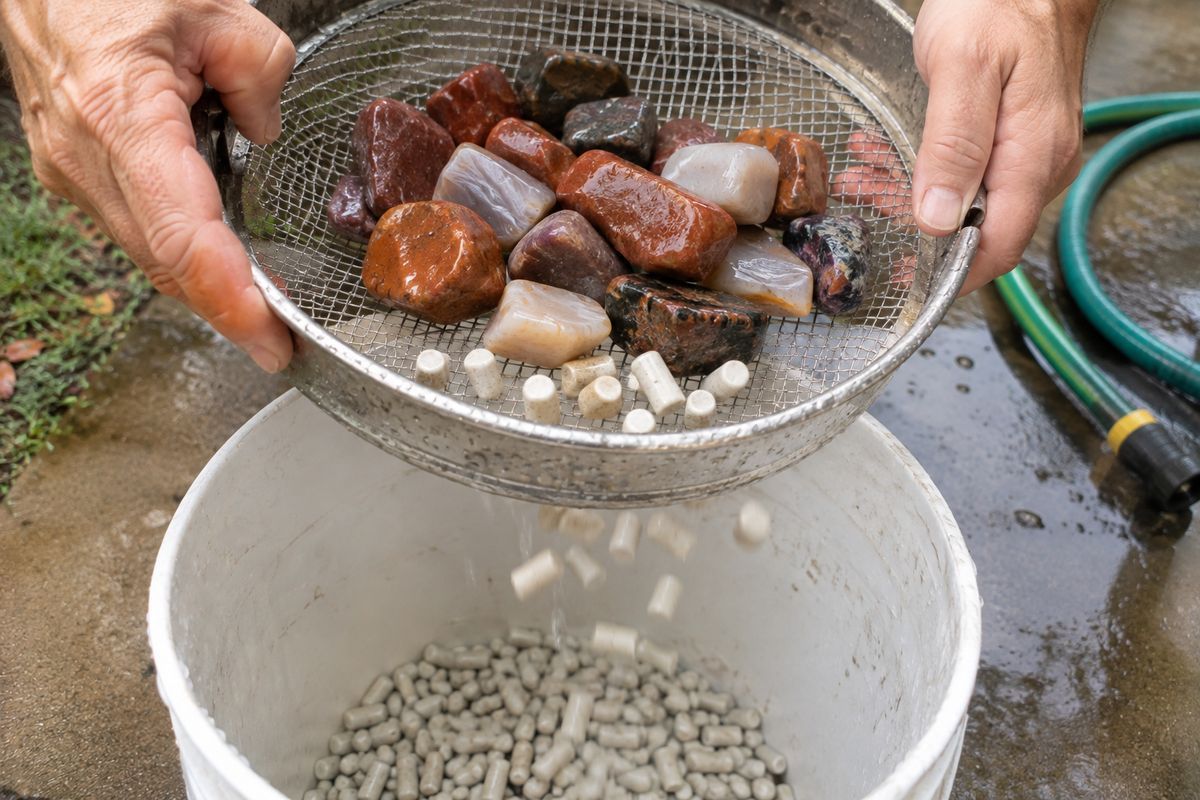
- Separate it at the end. After the polish, pour the batch through a screen with openings bigger than your media but smaller than your stones. The media drops through, and the stones stay on top. RockTumbler.com calls this kind of screen a classifier.
- Keep a media bucket. Store clean, smooth media in its own container. Add a little new large media to each coarse batch to replace what wears away.
- Watch it shrink. Small media lasts a few cycles. Large media lasts longer and slowly turns into small media, according to RockTumbler.com.
- Never pour slurry down a drain. Rinse media over a bucket, not the sink. Our guide to disposing of grit covers what to do with the sludge.
Common Media Mistakes
- Buying abrasive ceramic. Check for “non-abrasive” on the bag before you buy.
- New media in the polish. Break it in during the coarse and medium steps first.
- Plastic pellets in a vibratory tumbler. RockTumbler.com does not recommend them there. Use ceramic instead.
- Mixing plastic pellets between steps. One coarse grain carried into the polish can scratch a whole batch.
- Too much media with tough stones. Agate and jasper need little or none in the coarse step. Extra media takes up room that rocks could use to grind.
- Too little media with fragile stones. Obsidian and crystal quartz bruise easily. Give them at least half the load in media.
- Letting the level drop. Rocks shrink each step. Top up with media so the barrel stays about two-thirds full.
Rock Tumbler Media FAQ
What is rock tumbler media?
Rock tumbler media is a filler added to the barrel with your rocks, usually small non-abrasive ceramic cylinders or plastic pellets. It cushions the stones, fills space as they grind down, and helps carry grit to every surface. It is not the same as grit, which does the grinding.
Do I need media in my rock tumbler?
Not always. Durable stones such as agate and jasper need little or none in the coarse step if the barrel is full enough. You do need media for fragile stones, and it is an easy way to fill a barrel that is short on rock or to top up as rocks shrink.
How much ceramic media should I use?
For a rotary tumbler, RockTumbler.com suggests about 10 percent of the load for a general coarse batch and up to about 20 percent for a barrel of large rocks. It suggests 10 to 50 percent for less durable stones and at least 50 percent for fragile stones like obsidian. Then add enough to keep the barrel about two-thirds full.
Can you reuse ceramic tumbling media?
Yes. Ceramic rinses clean between steps. Large pieces last many batches and slowly wear into small pieces, and small pieces last a few cycles. Plastic pellets can be reused too, but only in the same grit step, because grit gets stuck in them.
Is ceramic or plastic media better?
Ceramic is the more common choice. It works in rotary and vibratory tumblers, helps with grinding, and moves between steps after a rinse. Plastic pellets only cushion, need a separate set for each step, and are not recommended for vibratory tumblers.
Can I use new ceramic media in the polish step?
It is better not to. New ceramic has sharp edges that can scratch stones. Break it in during the coarse and medium steps first, or run it alone for a few days in medium and then fine grit.
The Bottom Line
For most beginners with a small hobby tumbler, one 3-pound bag of mixed-size, non-abrasive ceramic media is a good start. Use little or none with agate and jasper in the coarse step, use at least half the load with obsidian or crystal quartz, and top up after every step to keep the barrel about two-thirds full. Break new media in before the polish, and keep a bucket of used media to top up from.
Next, see our how to tumble rocks guide for the full process, or the best rocks for tumbling to choose your first batch.