
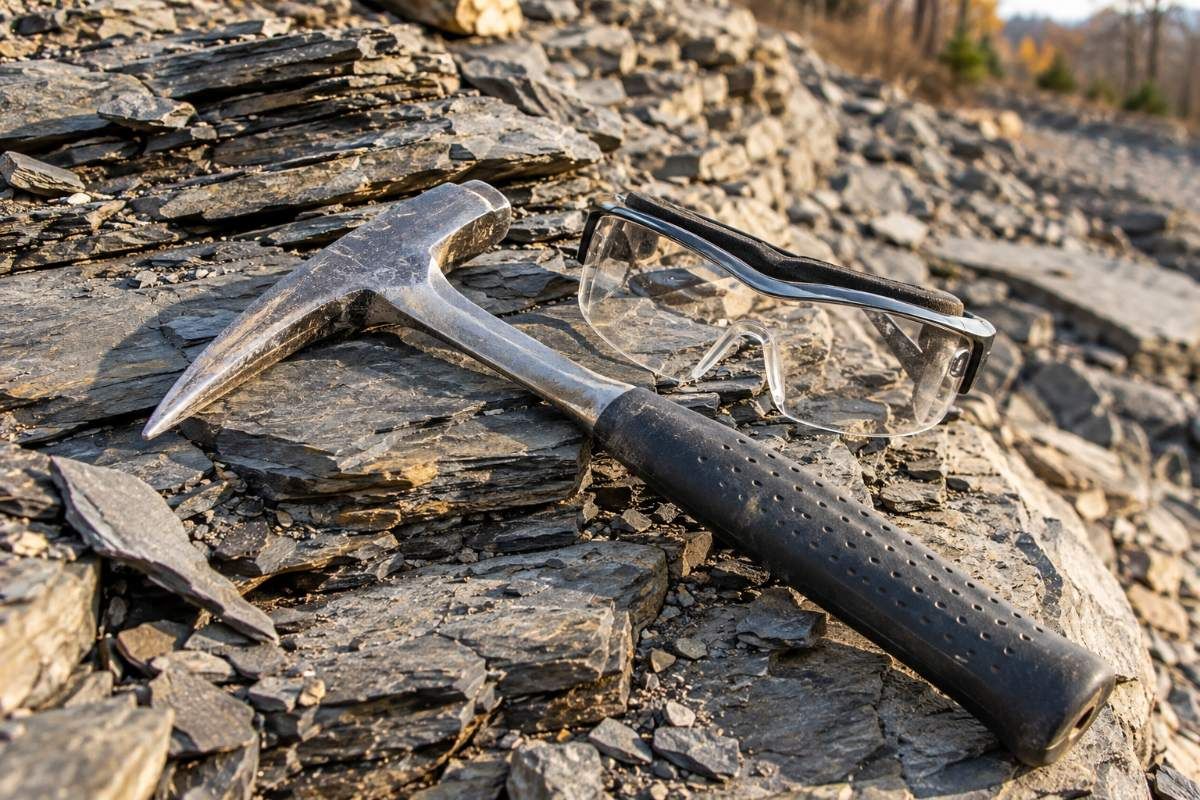
A rock hammer is a one-handed hammer with a flat, square striking face on one side and either a pointed pick or a flat chisel edge on the other. It is the basic tool for breaking rock, splitting layers to find fossils, and trimming specimens in the field. For most adults, a 22-ounce pick-tip hammer made from one piece of steel is a sensible starting point. Lighter 13- to 14-ounce hammers suit teens, smaller adults, and anyone who wants more control, and chisel-tip hammers suit layered rock like shale and slate.
Field to Polish is a participant in the Amazon Services LLC Associates Program, an affiliate advertising program designed to provide a means for sites to earn advertising fees by advertising and linking to Amazon.com.
This guide explains the two head styles, how to choose a weight, which extra tools you may need, how to swing safely, and where you may hammer on public land. It draws on university field-safety rules, federal land agencies, workplace safety standards, and manufacturer specifications. We have not tested these hammers ourselves, and product details come from maker catalogs and Amazon listings checked on October 12, 2026.
In This Guide
Quick Picks
- Best all-around rock hammer: Estwing E3-22P Rock Pick, 22 oz
- Best lighter hammer: Estwing E3-13P Rock Pick, 13 oz
- Best for layered rock and fossils: Estwing E3-20BLC Chisel Edge Rock Pick, 20 oz
- Best for driving chisels: Estwing B3-3LB Drilling/Crack Hammer, 3 lb
- Eye protection: 3M SecureFit 400 Safety Glasses with foam gasket
What a Rock Hammer Is
You will see this tool called a rock hammer, rock pick, or geologist’s hammer. The names mean the same thing. Every version has a flat, square striking face, and the opposite end is shaped for a different job: a pick point or a chisel edge.
A regular carpenter’s hammer is not a good substitute. Canada’s workplace safety agency, CCOHS, says not to strike stones or concrete with a hammer or use a hammer for a job it was not designed for. The best rock hammers are forged from a single piece of hardened steel, while hammers with wooden or tubular shafts cost less but are less durable for hard work like prying. Estwing, a company founded in Rockford, Illinois, in 1923, is known for hammers made from a single piece of hardened steel (Estwing on Wikipedia).
Geologists have relied on hammers for a long time. The US Geological Survey even keeps a photo of the prototype Nolan hammer. This long-handled sledge has a 3.7-pound head. A future U.S. Geological Survey (USGS) director developed it in the early 1930s, and USGS calls it a standard tool of hard-rock geologists.
Pick Tip or Chisel Tip: Which Do You Need?
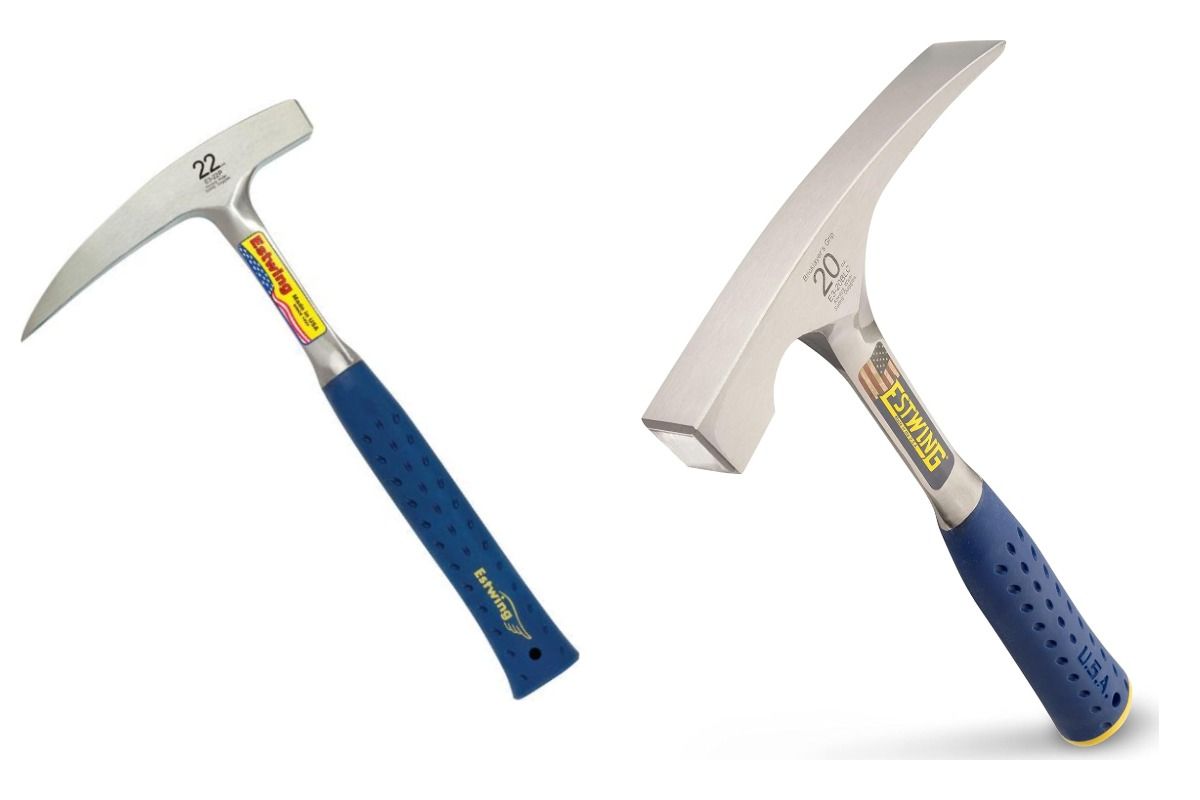
The right end depends on the rock you collect. Geology.com, which sells Estwing hammers, says chisel-tip hammers are used mostly in sedimentary bedrock for splitting layers, trimming samples, and digging in soil and sediment. It says pointed-tip hammers are used mostly in areas with igneous and metamorphic rock, with the pick used to pry rocks and search through soil and loose rock. Wikipedia adds that a pick point concentrates force on harder rock. In its section on chisel heads, it notes that rocks like slate and shale split easily, revealing fossils.
| Rock you find most | Common examples | Better tip | Why |
|---|---|---|---|
| Layered sedimentary rock | Shale, slate, mudstone, thin sandstone | Chisel tip | The flat edge slips into layers and splits them apart, which is how many fossils are exposed |
| Hard, massive rock | Granite, basalt, quartz veins | Pick tip | The point concentrates force and helps you pry pieces loose |
| Mixed or unknown | A beach, creek bed, or road cut with many rock types | Pick tip | It handles hard rock and prying, and you can add a chisel later |
If you mostly hunt agates and jasper in gravel bars, you will do more picking up than hammering. In that case, a lighter pick-tip hammer is enough to crack a stone open and check its inside. Our guide to rockhounding for beginners covers where to look.
How Heavy Should a Rock Hammer Be?
Rock hammer weights refer to the head only. Estwing’s catalog lists pick-tip models at 13, 14, 22, and 24 ounces and chisel-tip models at 16, 20, 22, and 24 ounces. A 22-ounce hammer is the standard weight for a pointed tip, but the 14-ounce version is much easier to control and less tiring to swing.
Heavier is not always better. A heavier head hits harder, but it tires your arm faster and is harder to aim, which matters when you are trimming a specimen instead of breaking a boulder. CCOHS also offers simple advice that applies here: choose a hammer that feels comfortable and is the right size and weight for the job.
| Head weight | Good for | Keep in mind |
|---|---|---|
| 8 to 14 oz | Teens, smaller hands, careful trimming | Less force for hard rock |
| 20 to 24 oz | Most adults, general collecting | The standard pick-tip weight, per geology.com |
| 32 to 64 oz (2 to 4 lb) | Hard rock, larger blocks, sledge-style geology hammers | Heavier to carry and harder to control |
| 3 lb crack hammer | Driving chisels and wedges | Not a rock pick, since it has two flat faces |
Sources do not fully agree on the ideal weight. Some references put the most useful range for geologists at 2 to 2.5 pounds (32 to 40 ounces), which is heavier than the usual 20 to 22 ounces. Professional geologists working hard rock all day may want more weight. For a hobby rockhound carrying a hammer on a long walk, 22 ounces or less is easier to live with.
Handle Length and Grip
Estwing’s standard-length rock picks run from about 10.75 to 13.5 inches long. Estwing also sells long-handle versions, such as a 16-inch pick-tip model and an 18-inch chisel-tip model, which give more reach and leverage. For grips, you can choose molded rubber or stacked leather. Estwing says its molded shock reduction grip reduces vibration by up to 70 percent. That figure comes from the company, and we couldn’t find an independent test. Many experienced geologists prefer leather grips.
Do You Also Need a Crack Hammer and Chisel?
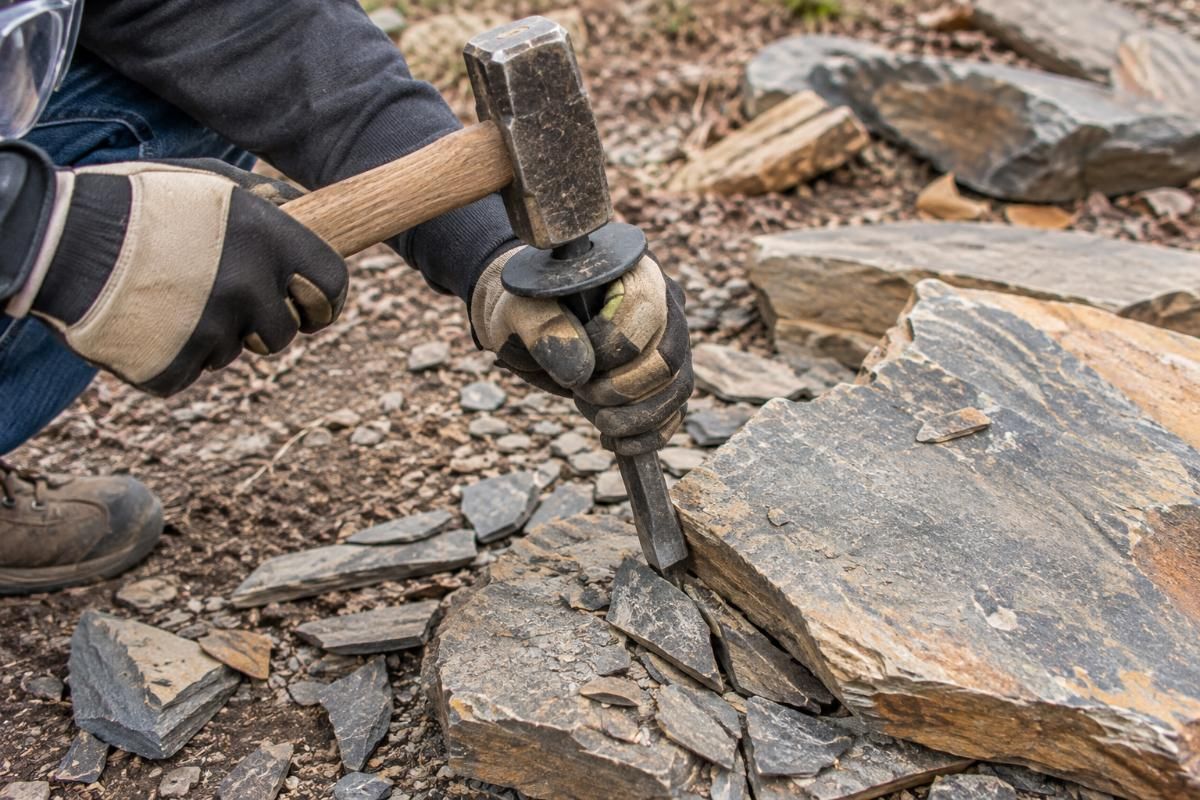
For a lot of collecting, a rock hammer is enough. But if you plan to split thick layers or cut a specimen out of solid rock, you will want a chisel and a separate hammer to drive it. Fossil groups and parks include this pairing in their gear lists. The Dallas Paleontological Society recommends cold chisels plus a 3-pound sledge or crack hammer. Penn Dixie Fossil Park in New York tells visitors to bring a rock pick, a 3- to 4-pound hand sledge, and a 1-inch masonry chisel with a hand guard.
A crack hammer, also called a drilling hammer or hand sledge, is a short, heavy hammer with two flat faces. It is the right tool for striking a chisel. Drilling hammers are made for striking chisels, so don’t drive a chisel with your rock pick, and never strike one hammer with another. Avoid striking a hammer against any other tool or hardened object, and use a hammer face about 3/8 inch larger than the chisel end you strike. If you are opening geodes, our guide on how to open a geode shows how to split one with a hammer and chisel.
Keep chisels in good shape, too. A chisel whose top has spread out and curled from repeated blows is called mushroomed, and those curled edges can break off and fly. The Occupational Safety and Health Administration (OSHA) rule for hand tools says impact tools such as chisels and wedges must be kept free of mushroomed heads, and Maine’s SafetyWorks! guide says never to use a chisel with a mushroomed head.
How to Use a Rock Hammer
Good technique protects both you and the specimen. A field techniques handbook from Royal Holloway, University of London tells students to hammer only when they truly need to, and to check for loose blocks and broken rock first. Many good specimens are already lying on the ground.
- Put on eye protection first, and make sure people nearby are wearing it or standing well back.
- Steady the rock. Set it on solid ground or another rock so it does not roll or bounce.
- Strike with the edge or corner of the flat face to split a rock. You deliver the blow with a corner or edge of the square head.
- Work with the layers. Rock laid down in layers can be split apart along them to reveal fossils. Use the chisel tip or a chisel along the layers to split them.
- Use controlled blows. A Kansas State 4-H geology guide warns that one careless blow can ruin a good specimen. A US Forest Service guide for trail crews who break rock also advises against raising a pick overhead while swinging.
- Keep your free hand out of the way. Steady the rock against the ground or another rock instead of holding it where you are striking.
- Cut out a large specimen instead of smashing it. The Kansas State 4-H guide suggests using a chisel to cut a trough around the piece, then undercut it.
Rock Hammer Safety Rules
Hammering rock throws sharp chips, and a hammer can flake steel off if it strikes another hammer. Rock bits fly off in all directions, so always wear eye protection. These are the rules that come up again and again in university and safety agency guidance:
- Wear safety glasses or goggles. Look for an ANSI Z87.1 marking, the American National Standards Institute safety standard for eye protection. Glasses marked Z87+ are rated for high impact. The federal workplace eye protection rule, 29 CFR 1910.133, is also based on the ANSI Z87.1 standard.
- Never strike two hammers together or use a second hammer as a chisel. CCOHS and Ohio State warn against hitting one hammer with another. Bits of metal can flake off the hammer and fly too. Never use a second geological hammer as a chisel.
- Keep others back. Washington and Lee University tells students not to stand close to, or watch, someone using a rock hammer because pieces of rock fly off.
- Protect your head near cliffs and in quarries. Hard hats are mandatory in quarries and mines, and you should never hammer under an overhang or on a loose rock face.
- Be careful at road cuts. Pull your vehicle completely off the road, and don’t back into the road while looking at the rock.
- Wear gloves. Work gloves are standard gear for hammering rock.
- Retire a damaged hammer. Discard a tool with a chipped or mushroomed face.
Where You Can Use a Rock Hammer
Owning a rock hammer does not mean you can use it anywhere. The rules depend on who manages the land. This is a general summary, not legal advice, so check with the local office before you go.
- Bureau of Land Management (BLM) land: The BLM generally allows people to collect reasonable amounts of rocks and minerals for noncommercial use. Collecting is not allowed on developed recreation sites, on active mining claims, or where the mineral rights are privately owned. Its Can I Keep This? page says hand tools are fine if they cause no more than minor surface disturbance. It limits petrified wood to 25 pounds plus one piece per day and 250 pounds per person per year, and it does not allow collecting any fossil with a skeletal structure.
- National forests: The US Forest Service rockhounding guide says you may not use mechanical equipment, may take only small, reasonable amounts for personal use, and must fill any holes. Rules can vary by forest, so call the local ranger district.
- National parks: Collecting rocks, fossils, and other natural objects is prohibited. Fossil collecting, like taking rocks and other natural objects, is prohibited in all national park units, so leave the hammer in the car.
- State parks and private land: State parks set their own rules. The Virginia Department of Energy fossil guide lists state parks with their own fossil rules and says to have permission before collecting on any land.
Rock Hammers for Kids
Hammers of 8 ounces or less are generally used casually or by children. Estwing’s lightest rock picks are the 13- and 14-ounce models, which suit teens and adults with smaller hands. Younger children can collect plenty without a hammer at all, or by watching an adult split rocks from a safe distance.
If a child does use a hammer, give them eye protection that fits snugly, close adult supervision, and clear rules. A Kansas State 4-H geology field trip guide tells young collectors to wear eye protection when hammering, avoid swinging hammers carelessly or throwing them, and watch for people below them on rock outcrops (bare rock sticking out of the ground).
How to Care for a Rock Hammer
A one-piece steel hammer needs little care, but inspect it before each trip. Estwing says to stop using any striking tool that shows chips, dents, or a mushroomed face, and to discard it. Wipe a tool down after use if it is dirty, greasy, or wet, and store it in a clean, dry place.
The Best Rock Hammers and Tools
We chose these from manufacturer specs and Amazon listings checked on October 12, 2026. Ratings and prices change often. Estwing makes most of the picks here because it publishes clear specs for each model, and its one-piece forged design matches the build described above as the best.
Pick 01Best all-around
Estwing E3-22P Rock Pick, 22 oz

The Estwing E3-22P is the 22-ounce pointed-tip hammer that geology.com calls the standard weight. It is forged from one piece of steel, measures 13 inches long per Estwing’s catalog, and features Estwing’s blue molded shock-reduction grip. The listing says it is made in Rockford, Illinois. It is one of the most popular rock hammers sold.
Good for: most adult rockhounds who want one hammer for mixed rock.
- Pros: one-piece steel, a common standard size, and a low price for the build.
- Cons: the pick tip is less useful for splitting thin layers, and the rubber grip feels different from leather.
If you prefer leather, the Estwing E30 is the same 22-ounce pick with a leather grip. If you want more reach, the Estwing E3-23LP has a 16-inch handle.
Pick 02Best lighter hammer
Estwing E3-13P Rock Pick, 13 oz

The Estwing E3-13P has a 13-ounce head, a smooth face, and the same shock-reduction grip. Its lighter head is much easier to control and less tiring than the 22-ounce size.
Good for: teens, adults with smaller hands, long hikes, and careful specimen trimming.
- Pros: light to carry, easier to aim, and a single-piece build.
- Cons: less force for hard igneous rock, where a heavier hammer or a crack hammer and chisel work better.
Pick 03Best for layered rock
Estwing E3-20BLC Chisel Edge Rock Pick, 20 oz

The Estwing E3-20BLC swaps the pick for a flat chisel edge. Chisel-tip hammers are used mostly on sedimentary rock to split layers, and layered rock such as shale and slate is where many fossils are found. Estwing’s catalog lists it at 11.25 inches long, with a shock-reduction grip. It has little buyer feedback so far.
Good for: fossil hunters and anyone who collects in shale, slate, or other layered rock.
- Pros: the right tip for splitting layers, with a mid-weight head.
- Cons: few ratings so far, and less useful for prying hard rock than a pick tip.
Pick 04Best for driving chisels
Estwing B3-3LB Drilling/Crack Hammer, 3 lb

The Estwing B3-3LB is a short, 3-pound hand sledge with two flat faces, the kind of hammer fossil clubs list for driving chisels. The Amazon listing calls it a mini sledge for use with chisels and punches and says it is forged in one piece.
Good for: anyone who needs to drive a chisel or split thick slabs.
- Pros: the correct tool for striking chisels, with a one-piece build.
- Cons: heavy to carry, and it is not a rock pick, so you will still want a rock hammer.
Pick 05Eye protection
3M SecureFit 400 Safety Glasses with Foam Gasket

The 3M SecureFit 400 glasses have a clear polycarbonate lens and a foam gasket that seals around the eyes. The listing says they meet the high-impact requirements of ANSI Z87.1-2020, which is the Z87+ level the UCLA safety office describes.
Good for: everyone who hammers rock, and anyone standing nearby.
- Pros: a high impact rating, low cost, and a gasket that blocks chips from the sides.
- Cons: the foam gasket may need replacing in time, and some people will prefer full goggles over glasses.
Rock Hammer FAQ
What size rock hammer should I get?
For most adults, a 22-ounce rock hammer is a sensible all-around size, and geology.com calls it the standard weight for pick tips. A 13- or 14-ounce hammer is easier to control and suits teens and smaller hands. Heavier tools, from 2 pounds up, are for hard rock and big blocks.
Is a chisel tip or pick tip better?
A chisel tip is better for splitting layered sedimentary rock such as shale and slate, where many fossils are found. A pick tip is better for hard igneous and metamorphic rock and for prying. If you are not sure, we suggest starting with a pick tip.
Can I use a regular hammer to break rocks?
It is not a good idea. CCOHS says not to strike stones with a hammer or use it for a job it wasn’t designed for, and hammers with wooden or tubular handles are weaker for prying. A one-piece rock hammer is built for the job.
Why should you never hit two hammers together?
Metal bits can flake off when one hammer hits another, and those pieces can fly. CCOHS, Ohio State, Penn Dixie, and Maine SafetyWorks! all warn against it. Use a crack hammer to strike a chisel instead.
Do I need safety glasses to use a rock hammer?
Yes. University field-safety guides, including those from Ohio State, Washington and Lee, and Royal Holloway, tell students to wear eye protection when hammering rock, because chips fly in all directions. Look for glasses marked ANSI Z87.1, and choose Z87+ for a high impact rating.
Can I use a rock hammer on BLM land?
Generally yes, for collecting reasonable amounts for personal use, as long as hand tools cause no more than minor surface disturbance. Collecting is not allowed on developed recreation sites, active mining claims, or land with private mineral rights, and you cannot collect fossils with skeletons.
Which Rock Hammer to Buy
Start with a 22-ounce, one-piece pick-tip rock hammer if you are an adult collecting mixed rock, or a 13- or 14-ounce model if you want something lighter. Choose a chisel tip if you mainly split shale or slate for fossils. Add a 3-pound crack hammer and a chisel with a hand guard for splitting thick rock, and never strike one hammer with another. No matter what you buy, wear Z87+ safety glasses and check the land rules before you swing. For the rest of a beginner kit, see our rockhounding tools guide. When you get your finds home, our guide to tumbling rocks shows how to polish them, and the rock tumbler buying guide helps you choose a machine.